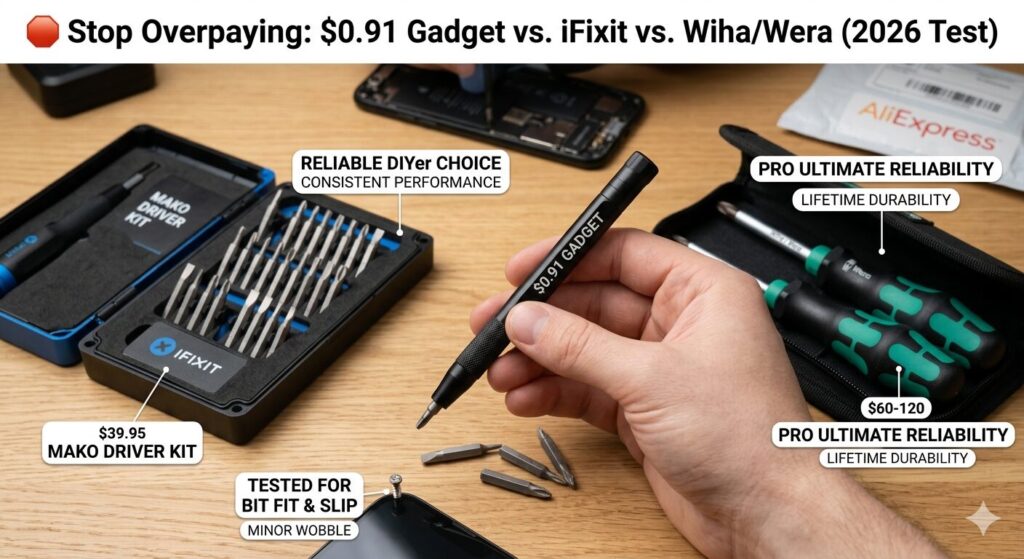
iFixit vs Wiha vs Wera:
Can a $0.91 Screwdriver Really Compete in 2026?
We put a very inexpensive 24-in-1 precision screwdriver pen kit against premium names including iFixit, Wiha and Wera. The result is more complicated than “cheap vs expensive.”
Can a screwdriver that costs less than a dollar really compete with iFixit, Wiha or Wera? That’s the question behind this 2026 precision screwdriver comparison.
Cheap precision screwdriver kits have become increasingly visible online, especially in short-form videos and marketplace listings. At the other end of the market are established tool brands such as iFixit, Wiha and Wera.
Rather than judging a screwdriver purely by its price tag, this comparison looks at practical factors: bit fit, wobble, torque handling, portability, convenience and suitability for electronics repair.
iFixit vs Wiha vs Wera vs Budget: Quick Comparison
If you only have 30 seconds, here’s the basic picture before we get into the detailed testing.
Budget 24-in-1 Pen Kit
Extremely portable, inexpensive and fast to deploy. Best suited to occasional light-duty use.
iFixit Mako
A dedicated electronics-oriented toolkit with a broad selection of precision bits.
Wiha
Professional-oriented precision tools emphasizing manufacturing consistency and durability.
Wera
Professional tool ecosystem with a strong focus on ergonomics, engineering and specialized applications.
The Five Things That Actually Matter
The Contenders: $0.91 vs iFixit vs Wiha vs Wera
1. The Budget Wildcard
The inexpensive 24-in-1 pen-style kit is the wildcard of this comparison. Its biggest advantages are size, portability and price.
For an emergency repair kit, office drawer, vehicle or occasional electronics job, a tiny multi-bit screwdriver can be surprisingly convenient.
2. iFixit Mako
The iFixit Mako occupies a very different part of the market. Its appeal comes from a large selection of precision bits and an ecosystem built around electronics repair.
For people working regularly on phones, laptops, game consoles and other electronics, the important question isn’t simply price — it’s whether the kit provides the right bits, consistent fit and a practical workflow.
3. Wiha
Wiha is widely associated with professional hand tools and precision applications. In this comparison, its role is the professional benchmark: consistent manufacturing, precision and durability are more important than minimizing the purchase price.
4. Wera
Wera is another established professional tool manufacturer with a broad range of screwdrivers, bits and specialized tools.
When comparing Wera with Wiha, the exact model matters enormously. A generic “Wiha vs Wera” comparison can hide major differences between individual products.
How We Compared Them
The comparison focuses on practical repair scenarios rather than a theoretical specification sheet.
Bit Fit & Wobble
The tools were examined for how securely the selected bit engages the fastener, particularly with small electronics screws.
Precision-focused testTorque & Slip
The comparison considered how confidently each tool could apply turning force without excessive movement or loss of control.
Control-focused testSpeed & Convenience
Portability, setup time and how quickly the tool could be taken out and used were considered.
Real-world usabilityThese observations are specific to the comparison described here. They are not a certified engineering test and should not be treated as a universal performance specification.
Test Results: Where the $0.91 Kit Succeeded — and Failed
Bit Fit & Wobble
In the reported comparison, the iFixit and professional tools provided more consistent engagement, while the inexpensive pen kit showed some wobble with very small security fasteners.
Torque & Screw Control
The budget kit was usable, but higher-force work requires more control. Professional tools are designed for repeated use where consistency, grip and durability matter.
This is one area where comparing only the purchase price can be misleading. A professional technician may value repeatability more than the lowest possible entry cost.
Speed & Portability
Here’s where the inexpensive pen-style design becomes interesting. Its compact size makes it extremely easy to carry and deploy.
iFixit vs Wiha vs Wera: Detailed Comparison
| Factor | Budget Kit | iFixit | Wiha | Wera |
|---|---|---|---|---|
| Typical use | Occasional/light repairs | Electronics & DIY repair | Professional/precision work | Professional/general tool use |
| Portability | Excellent | Very good | Model dependent | Model dependent |
| Bit selection | Good for the price | Broad precision selection | Model dependent | Model dependent |
| Small fastener control | Variable | Strong | Professional-focused | Professional-focused |
| Heavy repeated use | Not the primary strength | Good for intended applications | Designed for professional use | Designed for professional use |
| Entry cost | Extremely low | Mid-range | Premium | Premium |
iFixit vs Wiha: Which Type of User Needs Which?
This isn’t necessarily an either-or decision. iFixit and Wiha serve overlapping but different tool-use scenarios.
If your work is primarily electronics repair, the bit selection, organization and repair-oriented design of an iFixit kit may be particularly relevant.
If you’re looking for professional precision tools for repeated work, the specific Wiha model, handle design, bit specification and intended application deserve closer attention.
Wiha vs Wera: What’s the Difference?
Searching for “Wiha vs Wera” without specifying a model can produce an incomplete comparison. Both companies sell many different tool categories.
For a meaningful comparison, identify the exact screwdriver or bit set, then compare:
- Bit type and dimensions
- Handle ergonomics
- Intended application
- Durability requirements
- Warranty and replacement options
- Actual purchase price
iFixit vs Wera: Electronics Repair or Professional Tooling?
iFixit has a strong association with electronics repair, while Wera offers a much broader professional tool ecosystem.
For a laptop, phone or game-console repair, the most important question may simply be whether the kit contains the exact bit you need and provides reliable engagement with the fastener.
For repetitive professional work, durability, ergonomics and consistent handling can become more important than the initial price.
Which Screwdriver Should You Choose?
Choose a Budget Kit If…
- You need an inexpensive backup tool.
- You perform occasional light repairs.
- Portability is extremely important.
- You want a small emergency kit.
- You don’t expect intensive daily use.
Choose iFixit If…
- Your main interest is electronics repair.
- You regularly work on small devices.
- You want a broad selection of precision bits.
- You value a repair-oriented toolkit.
Consider Wiha or Wera If…
- You use precision tools frequently.
- Consistency matters more than the lowest purchase price.
- You need professional-oriented equipment.
- Durability and ergonomics are important over many repair sessions.
The $0.91 Tool Experiment: Why Cheap vs Expensive Is So Shareable
The reason this comparison is interesting isn’t simply that one tool costs less. It’s the enormous gap between the prices.
A roughly dollar-sized purchase being compared with tools costing tens or potentially more than a hundred dollars creates an obvious question:
That’s a useful question for almost any tool category: screwdrivers, soldering equipment, measuring tools, cables, adapters and workshop accessories.
Share this comparison with someone who has ever bought an expensive tool and then wondered whether the cheap version would have worked.
Frequently Asked Questions
Is iFixit better than a cheap precision screwdriver?
Is Wiha better than Wera?
Can a $0.91 screwdriver actually be useful?
What is the best screwdriver for electronics repair?
Are expensive precision screwdrivers worth it?
iFixit vs Wiha vs Wera — which should I compare?
Don’t Compare Brands. Compare the Job.
The most useful screwdriver isn’t necessarily the most expensive one. It’s the one that matches the fastener, application, frequency of use and level of precision you actually need.
If this experiment surprised you, share it with another DIYer, technician or tool enthusiast and see what they think.
SmartChoiceLinks comparisons are intended for informational purposes. Prices can change, products can vary by model and seller, and individual test conditions may affect results.


Leave a Reply