
The municipal archive smelled like dry paper and sleeping things. Lena worked nights there because the quiet let her think — and because at night the city’s small cruelties felt muffled. The building was one of those old places with bones: narrow stairs, a kettle that whistled itself, and doors that complained when they opened.
On a Tuesday, a plain parcel arrived on her desk with no return address. Inside was a slim notebook bound in scarred cloth and a small index card tucked between the first pages. The card had only one line in a cramped hand:
“Do not speak the names. Read only with your eyes.”
She flipped through the notebook. It wasn’t a journal. It was an inventory: names, brief descriptions, dates, and faint pencil annotations. The handwriting was old but precise. Room numbers, job titles, odd details — “left-handed,” “plays flute,” “hates pigeons.”
The last entry was circled in red: “M. Rivera — librarian, night shift — Room 11 — 11/09 — pending.” Lena’s fingers went cold. Her own name was nowhere in the book, but the margin next to the Rivera line carried an extra note: “Watch for the silence.”
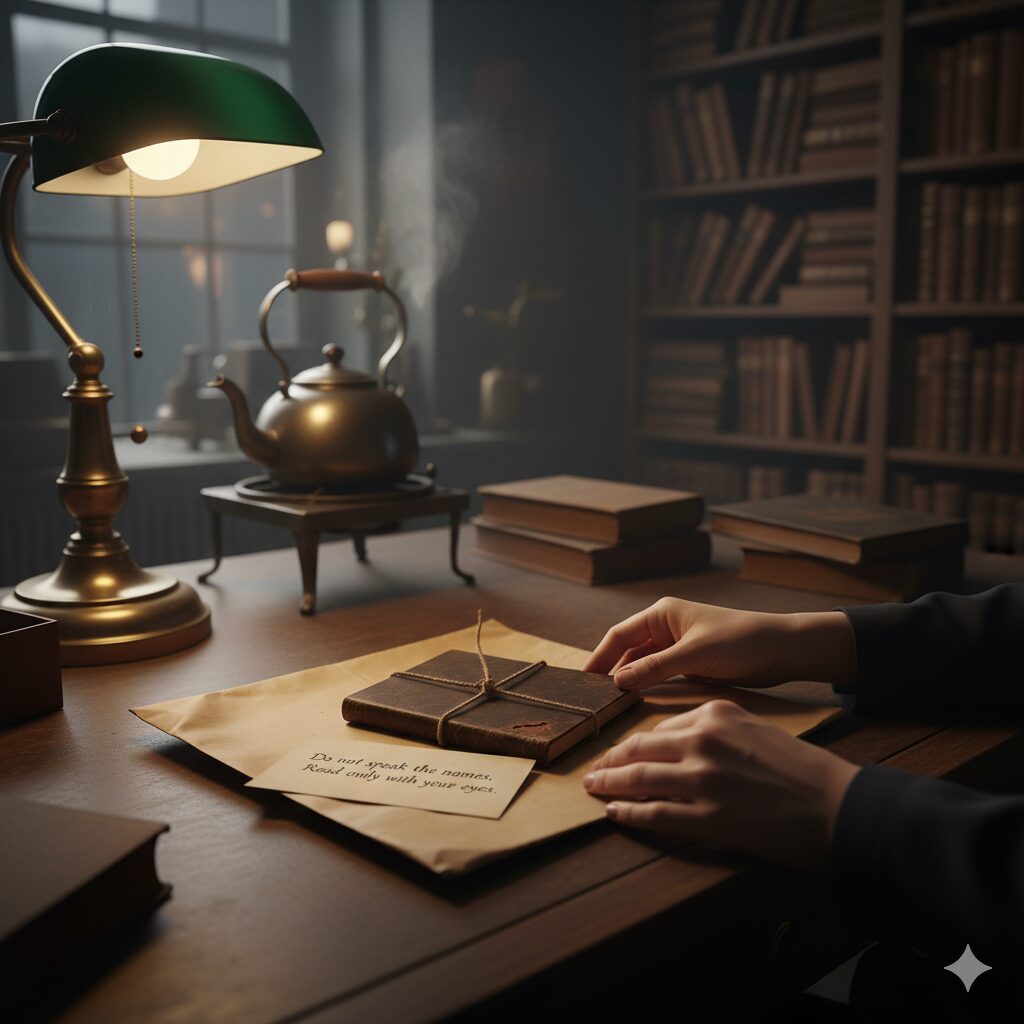
At 2:13 a.m., the kettle that never boiled began to whisper. She smiled at herself and read on. She convinced herself it was a prank — some old hand with a taste for catalogues. Still, she put the notebook into a drawer and locked it. She turned out the lights and walked the stacks until the building felt like an animal breathing.
Three nights later, the senior archivist, Mr. Halvorsen, didn’t come in. He had been at his desk the previous evening and had waved Lena off with a grunt about a late delivery. His desk was there but empty. On top of his calendar sat a sticky note: “Left at 6:02.”
A week went by. The city called Halvorsen’s apartment to confirm: no answer. A neighbor mentioned he’d left for “a short walk” and never returned. Lena closed the drawer where she’d hidden the cloth notebook, but she could not erase the mental image of one of its entries: “H. — last seen near the canal.”
She reopened the notebook and read the page where Halvorsen’s name had been. There, in pencil that hadn’t been there before, someone had added: “Silence confirmed. No callers.”

Lena put the book down. She told herself not to speak of it and, buoyed by the index-card command, she didn’t say a word — to anyone. She only read.
Two nights later the printer in the reference room spat out a single sheet of paper by itself: a list of names, typed. At the top, in bold, was ROOM 11. Lena’s breath hitched. She thought of the old floor plans she’d studied when she’d first been hired. Room 11 was a space on the lowest level: a maintenance room left sealed after the fire decades ago and rumored to hold obsolete equipment and, some said, things the city had simply decided to forget.
She found the door to the lower level behind a stack of wooden shelving. The lock was a simple rusted padlock. Someone had left it open.
The room smelled of old glue and winter. In its center sat a metal cabinet whose drawers were labeled in neat, typewritten tags: ELEC, MISC, RECORDS. One drawer had been pulled open. Inside — dozens of folded slips of paper, each with a name at the top. Lena’s hands trembled as she read a few: local musicians, a baker who moved away, a teacher who took early retirement. Each slip had a tiny stamped mark: a circle with a dot. Beside one of the slips, someone had scribbled in the same cramped hand from the cloth notebook:
“Taken from the ledger. Stored out of public memory.”
Stored out of public memory. The phrase lodged under her ribs like a splinter. She carried one folded slip to the light. When she unfolded it, the paper was blank except for a single line written down its margin: “Speak the name and it will fall away.”
She froze.

She imagined aloud for a second — a bitter little test — what would happen if she said a name, any name, out loud in the room. The idea felt obscene and childish, but curiosity gnawed. She did not say anything. Instead she put the slip back, closed the drawer, and left the door of Room 11 unlocked.
From that night, Lena did what she’d been told in the parcel: she read with her eyes and did not speak the names. She watched the list. She found names she knew, people who vanished from the small arcs of her life as if someone had gently turned down their lights: a coffee vendor who’d worked on Market Row for years whose stall suddenly had a new owner and no forwarding address; a neighbor’s cousin who was “out of town” and then simply absent from every family conversation. Each absence was small at first. Each absence came with a quiet the city seemed to accept.
Weeks passed and the notebook grew new entries in the margins as though someone else had been keeping the ledger while Lena slept. One night, a new line appeared next to an old name: “A. Duvall — confirmed. Memory erased from records. Family memory unaffected.” That was the strangest — records gone, paperwork shredded, yet the person was still living in memory at home. The mechanism was surgical: remove the public trace but leave the private fabric intact.
Obsessed and sleepless, Lena began to test the edges of the thing. She would stand in the street and ask the names of people she remembered, only to find the world rearranged in micro-ways: a shop with a different sign, a bus number missing from the route. Each erasure smoothed away like a pebble in a tide.
On a rain-slick night, she returned to the metal cabinet and pulled out a slip at random. This time the name was hers. Her own full name, written in the same exact hand, with a date circled beside it: “11/26 — pending.”
The paper trembled in her fingers. Somewhere outside, the city sounded like a living thing shifting its weight. Lena read the margin note — a line she could not believe she’d ever read about herself: “Remember only in private. Public ledger to be closed.”

She tested the rule because the notebook and the index card had taught her method: do not speak; only read. She whispered the name of someone else — the baker from the slips — under her breath and heard nothing change. But when she let the syllables of her own name brush her lips in an accidental murmur, something in the room tightened. The lights in the room flickered and then steadied like breath held and let go.
Lena clutched the slip and felt the world tilt. She counted to three and did what she had always promised she would never do.
She spoke a name.
It was the name on the slip. Her own name.
The building exhaled.
A silence came down that was absolute. It wasn’t just the absence of sound; it was the absence of confirmation. The kettle’s whistle never sounded again. The phone lines on the third floor registered no ring. The municipal website later showed an administrative update removing her position with an odd, bureaucratic note: “Position dissolved.”
Her friends called and left messages that turned to static mid-sentence. Her mother dialed once and then wrote a single note in pencil: “You were here. I remember.” The world kept private memory — the people who loved you — but to the city and its records you had become a blank line.
Lena learned the rule — the ledger was never meant to be read, nor were its names meant to be uttered. The mechanism was not supernatural in the spectacular sense; it was administrative, a terrible bureaucratic apparatus that could excise presence from the public ledger, leaving only personal remembrance like an ember.
In the final entries of the cloth notebook, Lena found one line that chilled her more than anything:
“Those who break the rule are sometimes given the choice to leave or to take the place of what protects the ledger.”
When she looked up from the paper, the metal drawer beside her had shifted slightly open, as if inviting her hand. On the lip of the drawer, a new slip had been placed with the neatest handwriting she had ever seen. It read:
“Room 11 — Custodian needed.”
Lena folded the slip and slid it into her pocket. She felt the ledger’s weight.
She understood then: the city did not simply delete. It traded. It traded visibility for silence. It sought someone who would watch the names without speaking them, who would keep the ledger bound and the doors closed — someone to keep the mechanism from undoing itself.
She could burn the notebook. She could shout the names and risk erasing more than her own presence. She could walk away and hope the system chose another hand.
But in the drawer, the slip with her name had not yet been stamped final. The date was near but not fixed. The ledger was patient.
Lena closed Room 11, locked it, and walked up the stairs into the night. She looked at the city with new eyes — as if every face could slide away if you said it aloud. She began to memorize the names she loved and never spoke them out loud again. She learned to keep watch with her eyes.
On a Tuesday, months later, someone left a plain parcel on the archivists’ desk: a slim cloth-bound notebook and an index card with one line written in a cramped hand.
“Do not speak the names. Read only with your eyes.”
She set the parcel under a lamp and, with a steady hand, wrote a single note of her own into the margin of the cloth notebook:
“If you guard the ledger, guard your silence.”
Then she added one more line, smaller, almost like breath:
“And if you ever tire, Room 11 will always have a drawer open.”
When she slid the notebook into the drawer and shut it, she slipped a new, blank slip into the outer pocket — one ready to be filled by a future name, one that might or might not be hers.
#TheSilenceOfRoom11 #ThrillerStory #MysteryFiction #SuspenseRead #DarkFiction #OriginalStory #CreepyTale #ShortThriller #UnexplainedMystery #MustReadStory

Leave a Reply