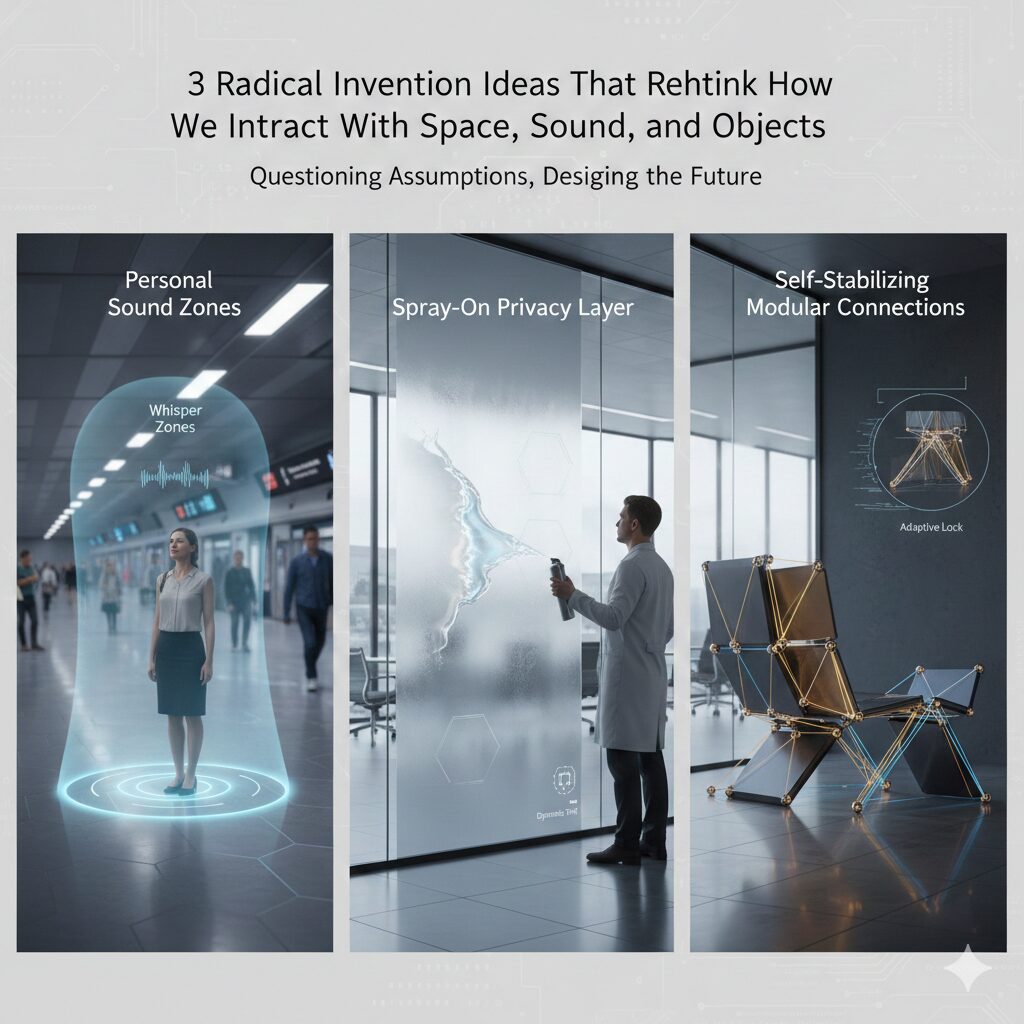
3 Radical Invention Ideas That Rethink How We Interact With Space, Sound, and Objects
True innovation doesn’t always come from improving what already exists — sometimes it comes from questioning assumptions we no longer notice.
Below are three original invention concepts designed to challenge how we experience sound, privacy, and physical connection in everyday environments. These ideas are presented at a conceptual level only, without revealing proprietary mechanisms or patentable implementations.
1. Personal Sound Zones Embedded in the Ground
Imagine standing in a public space — a train station, a museum, or a shopping center — and hearing information meant only for you, without headphones and without disturbing anyone around you.
This concept envisions floor-based sound zones that activate only when a person steps into a specific location. The sound does not fill the room; instead, it exists only within a tightly defined personal area.
Each individual hears guidance, alerts, or contextual information relevant to where they are standing — while everyone else hears silence.
Why this matters:
- Eliminates noise pollution in public spaces
- Enables accessibility without visual overload
- Allows hyper-local communication without wearables
This idea redefines public audio not as a broadcast, but as a spatial interaction.
2. A Spray-On Privacy Layer for Transparent Surfaces
Privacy solutions for glass surfaces today are rigid, expensive, and permanent. This concept challenges that model entirely.
Imagine a liquid coating that can be applied like paint or spray — transforming a transparent surface into one that can dynamically shift between clear visibility and visual privacy.
No heavy installations. No fixed films. Just a thin, adaptive layer that responds to user intent.
Potential impact:
- Instant privacy for offices, homes, vehicles, and hospitals
- Temporary or mobile privacy without structural changes
- New possibilities for architecture and interior design
Rather than replacing glass, this idea allows glass to become intelligent — only when needed.
3. Self-Stabilizing Modular Connections for Physical Objects
Most physical connectors rely on friction, screws, or permanent locking mechanisms. This concept explores a new category: connections that adapt their strength dynamically.
Imagine modular objects — furniture, tools, or structural elements — that can be loosely connected when adjustment is needed, then become rigid and stable without manual tightening.
The connection itself responds to conditions, creating stability without complexity.
Why this is transformative:
- No tools required for assembly or reconfiguration
- Improved durability and vibration resistance
- Cleaner design with fewer mechanical parts
This idea challenges the assumption that strength must come from force — instead, it comes from smart adaptation.
Final Thoughts
These concepts are not incremental upgrades. They represent shifts in how we think about interaction:
- Sound that belongs to a place, not a device
- Privacy that adapts instead of obstructs
- Connections that think instead of resist
Innovation begins with ideas that feel slightly uncomfortable — because they don’t fit existing categories.
The future belongs to those willing to design beyond them.
— Oren Sharon
#Innovation #FutureTech #InventionIdeas #DisruptiveInnovation #DeepTech #SmartDesign #NextGenTechnology #ConceptInnovation #TechnologyTrends #IntellectualProperty #PatentPending #InventorsMindset #TechVision #ProductInnovation #FutureOfDesign

Leave a Reply