How Oil Is Formed in Nature: From the First Day to the Last Drop
Oil may feel like a modern resource, but its story begins hundreds of millions of years ago. The formation of oil is one of the longest and most fascinating natural processes on Earth, involving sunlight, microscopic life, geology, pressure, and time on an almost unimaginable scale.
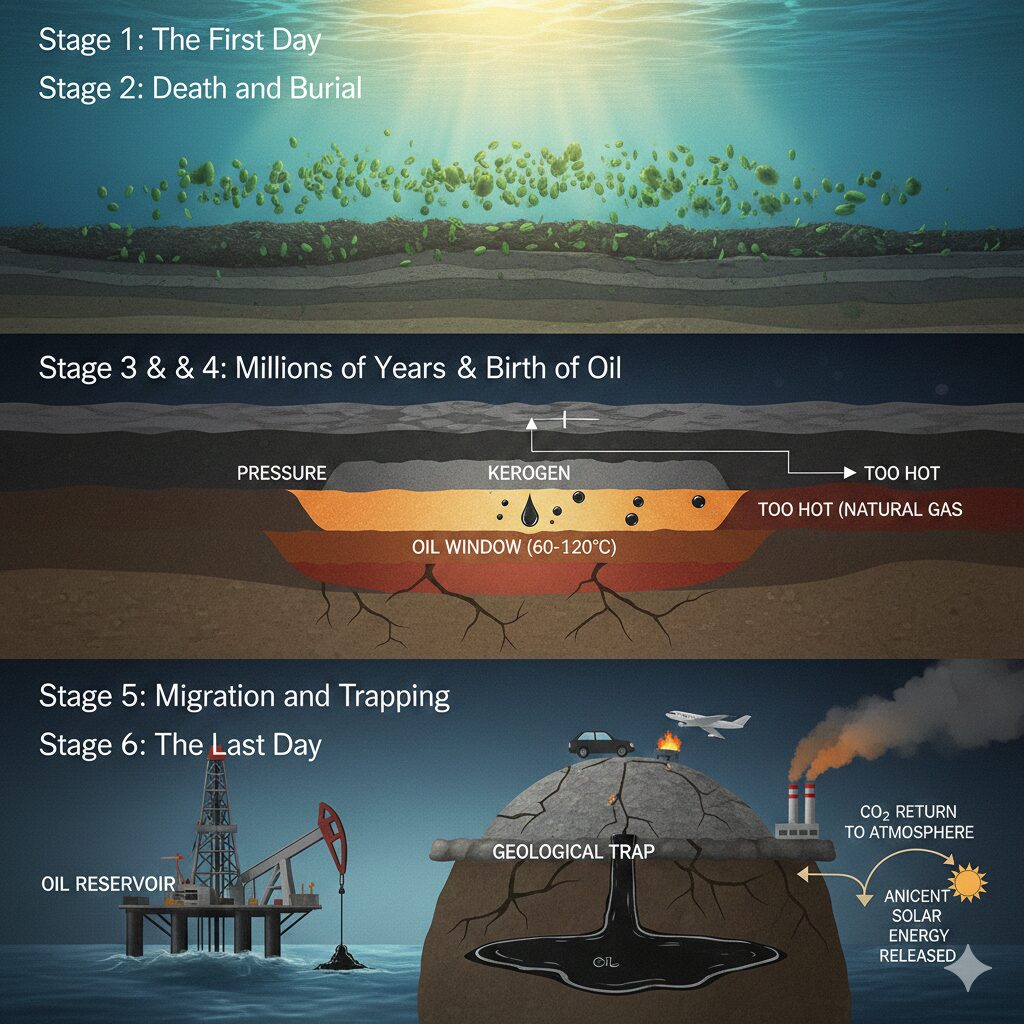
Stage 1: The First Day – Sunlight and Life
The story of oil begins with the Sun.
Hundreds of millions of years ago, Earth’s oceans were filled with microscopic plants and organisms such as algae and plankton. These organisms used photosynthesis to capture sunlight and convert carbon dioxide and water into organic matter.
This process stored solar energy inside chemical bonds. At this moment, the energy that would one day power cars, planes, and factories was first captured.
Stage 2: Death and Burial on the Ocean Floor
When these microscopic organisms died, they sank to the ocean floor. Over time, they were buried under layers of mud, sand, and sediment.
In many areas, oxygen levels were very low. This lack of oxygen was crucial because it prevented the organic material from fully decomposing. Instead of rotting away, it was preserved.
Stage 3: Millions of Years Under Pressure
As more sediment accumulated, the buried organic material was subjected to increasing pressure and temperature.
Over millions of years, it transformed into a waxy substance known as kerogen. Kerogen is the intermediate material between dead organisms and oil.
At this stage, oil had not yet formed—but the ingredients were ready.
Stage 4: Geological Cooking – The Birth of Oil
At depths of roughly 2 to 4 kilometers below the surface, temperatures reached between 60°C and 120°C. This range is known as the “oil window.”
Within this window, heat slowly broke kerogen into liquid hydrocarbons (oil) and natural gas.
- Too little heat: no oil forms
- Too much heat: oil becomes gas
Only precise geological conditions allow oil to form.
Stage 5: Migration and Trapping
Oil does not stay where it is created.
Because it is lighter than surrounding rock and water, oil slowly migrates upward through tiny cracks and porous rocks. If it encounters a geological trap—porous rock sealed by an impermeable layer above—it accumulates.
This is how oil reservoirs are formed.
If no trap exists, the oil continues migrating until it escapes or degrades.
Stage 6: The Last Day – Extraction and Combustion
Humans drill into these reservoirs, extract the oil, refine it, and eventually burn it as fuel.
When oil is burned:
- Stored chemical energy is released as heat and motion
- Carbon dioxide returns to the atmosphere
- The ancient energy completes its cycle
In seconds, energy stored for hundreds of millions of years is released.
Why Oil Is Considered Solar Energy
Oil is often described as stored solar energy because:
- The original energy source was sunlight
- Photosynthesis captured that energy
- The energy was locked into chemical bonds
- Geological processes preserved it for millions of years
- Burning oil releases that ancient solar energy
In simple terms:
Oil is sunlight from the distant past, released in the present.
Why Oil Is Not Renewable
Nature needs millions of years to create oil, but humans consume it in seconds. This imbalance is why oil is classified as a non-renewable resource.
Once burned, it cannot be replaced on any human timescale.
Final Thoughts
Every drop of oil represents a deep-time collaboration between the Sun, life, Earth’s geology, and time itself. Understanding this process reveals why oil is both incredibly powerful and incredibly limited.
When we burn oil, we are not just using fuel—we are releasing ancient sunlight trapped since the age of dinosaurs.
#OilFormation #FossilFuels #SolarEnergy #EnergyScience #Geology #EarthScience #HowOilIsFormed #AncientSunlight #NaturalResources #EnergyHistory #ClimateScience #CarbonCycle #ScienceExplained #NonRenewableEnergy #EnvironmentalAwareness

Leave a Reply