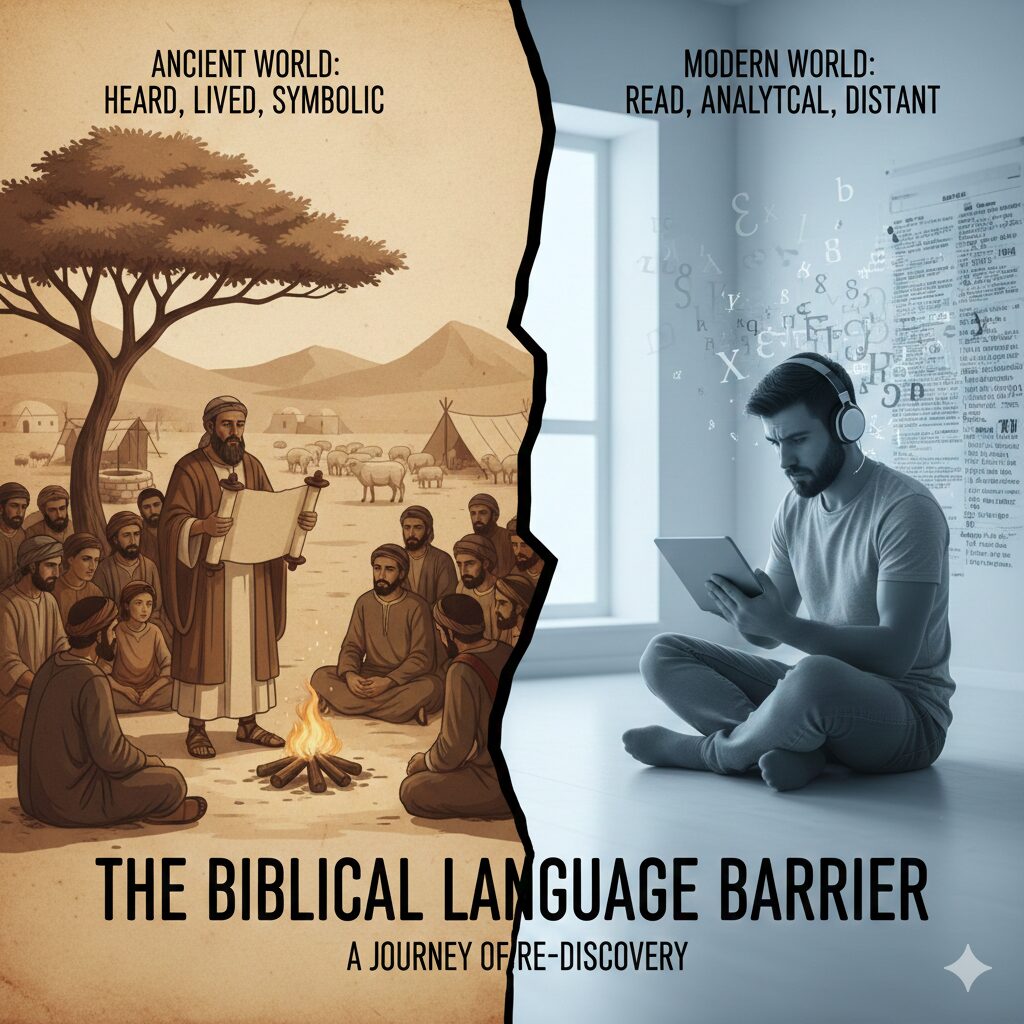
Why Biblical Language Feels Unintelligible to the Modern Reader
Many modern readers—especially secular ones—open the Bible and quickly feel lost. The language feels foreign, opaque, repetitive, and emotionally distant. This reaction is not a failure of intelligence, faith, or sensitivity. It is the result of a profound gap between two worlds.
This article explains why Biblical language feels so difficult, how it came to be that way, and why the Bible was never meant to be read like a modern book.
1. Biblical Hebrew Is Not Modern Hebrew
Although both are called “Hebrew,” Biblical Hebrew and modern Hebrew are fundamentally different linguistic systems.
- Modern Hebrew was reconstructed in the 19th–20th centuries
- Its syntax follows European languages
- Many Biblical words changed meaning entirely
Example: The Biblical word “to know” does not mean intellectual knowledge. It means experience, intimacy, embodied understanding. When modern readers apply today’s meanings, the text collapses.
2. The Bible Was Written for a Different Cognitive World
Modern thinking is linear, analytical, and causal. Biblical thinking is symbolic, cyclical, and associative.
The Bible often:
- Repeats events intentionally
- Holds contradictions without resolving them
- Omits psychological explanations
Modern readers ask: “What exactly happened?”
Biblical texts ask: “What does this mean for existence?”
3. The Bible Was Meant to Be Heard, Not Silently Read
Most Biblical texts were composed for oral transmission.
- Public reading
- Rhythm and repetition
- Memory-based culture
What feels redundant or awkward on the page often carries power when spoken aloud. Silent, individual reading strips the text of one of its primary dimensions.
4. Biblical Language Is Symbolic, Not Explanatory
The Bible does not explain emotions, motivations, or psychology. It assumes shared cultural symbols.
Land, blood, covenant, exile, wilderness—these are not metaphors. They are lived realities. Modern readers no longer inhabit these symbolic systems, so the language feels empty or cryptic.
5. It Is a Ritual and Legal Language, Not a Casual One
Much of Biblical language resembles:
- Legal texts
- Ritual formulas
- Mythic proclamations
No one expects to fully grasp legal or philosophical texts without training—yet we expect instant clarity from the Bible.
6. Why the Distance Feels So Strong Today
The modern individual is detached from:
- Agricultural life
- Tribal identity
- Absolute metaphysical frameworks
The Bible assumes a world where God, land, family, and fate are inseparable. That assumption no longer exists for many readers.
7. A Final, Crucial Insight
The Bible was never designed to be immediately understood.
It was written to be revisited, debated, wrestled with, and reinterpreted across generations. In this sense, it resembles philosophy or myth more than modern literature.
The confusion modern readers feel is not a flaw—it is an invitation.
Conclusion
If Biblical language feels distant, strange, or inaccessible, it is because it comes from a radically different human experience. Understanding it requires learning its world—not forcing it into ours.
The problem is not that the text is obscure. The problem is that it refuses to adapt itself to modern expectations.
And perhaps that resistance is exactly why it has survived.
SEO Hashtags:
#BiblicalLanguage #BibleInterpretation #BiblicalHebrew #AncientTexts #Theology #Philosophy #ModernReader #HebrewBible #ReligionAndCulture #Linguistics

Leave a Reply