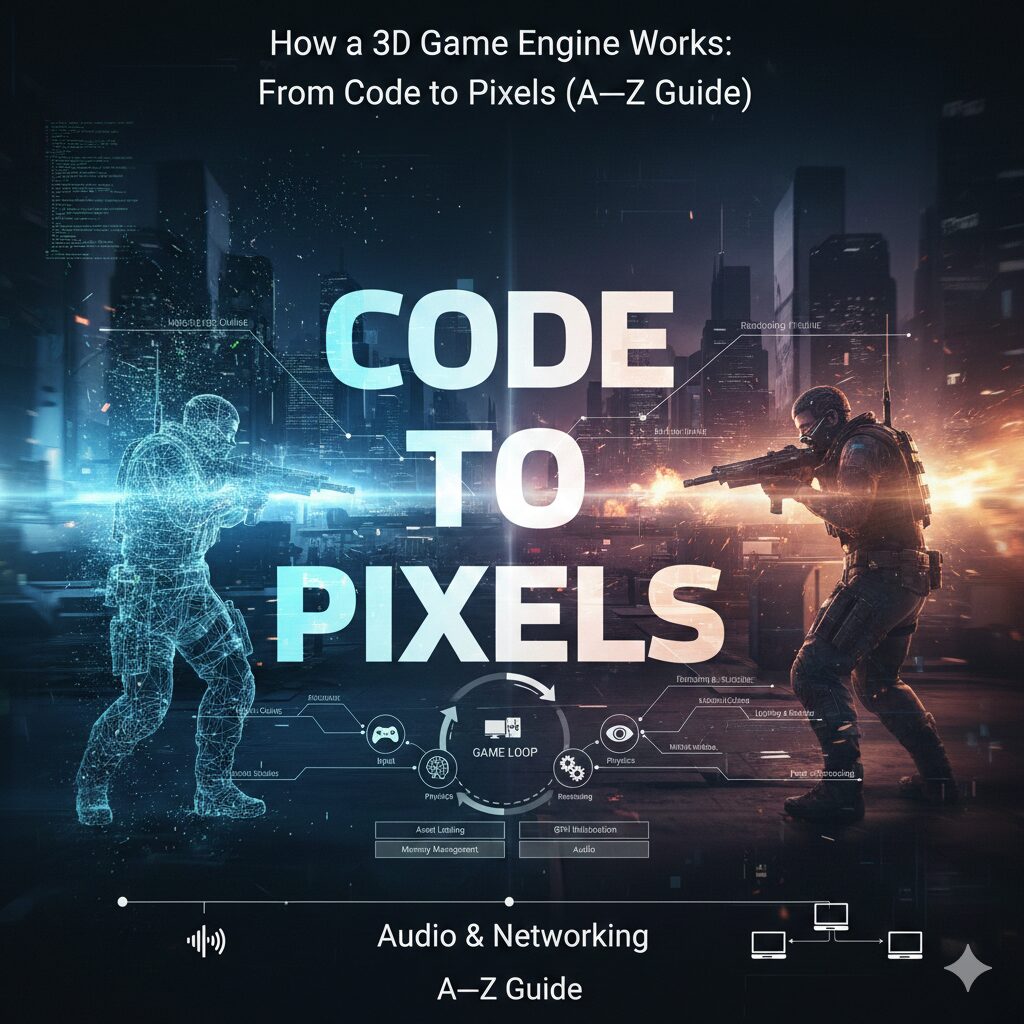
How a 3D Game Engine Works: From Code to Pixels (A–Z Guide)
Ever wondered how a modern video game like Call of Duty transforms player input into realistic worlds, smooth gunplay, and cinematic visuals — all in real time? This guide explains how a 3D game engine works from start to finish, breaking down every major system involved.
What Is a 3D Game Engine?
A 3D game engine is a real-time software framework that manages graphics, physics, animation, audio, input, AI, and networking. It continuously converts player actions into visible, interactive experiences — usually 60–120 times per second.
Step 1: Game Startup & Engine Initialization
When you launch a game, the engine initializes hardware resources such as the CPU, GPU, memory, audio devices, and input systems. Core engine modules like rendering, physics, and asset management are loaded into memory.
Step 2: Asset Loading & Optimization
3D models, textures, animations, and sound files created by artists are converted into optimized formats. This process reduces loading times, memory usage, and ensures assets are GPU-friendly.
Step 3: The Game Loop (The Engine’s Heart)
Every game engine runs a continuous loop:
- Read player input
- Update game logic
- Simulate physics and AI
- Render the next frame
- Play audio
This loop runs dozens of times per second, creating the illusion of a living world.
Step 4: Input, Game Logic & Physics
Mouse clicks, keyboard presses, or controller movements are translated into in-game actions. Physics engines calculate movement, gravity, collisions, and bullet hits — often using ultra-fast techniques like raycasting for instant weapon responses.
Step 5: AI & Animation Systems
Enemy behavior is controlled through behavior trees or state machines, while character animation relies on skeletal rigs and animation blending. Advanced techniques like inverse kinematics ensure realistic foot placement and weapon handling.
Step 6: The Rendering Pipeline (Where Graphics Are Born)
The rendering pipeline determines what objects are visible, sends them to the GPU, and transforms 3D geometry into 2D pixels. This process includes:
- Visibility culling
- Vertex and pixel shaders
- Lighting and shadows
- Post-processing effects
Step 7: Lighting, Effects & Post-Processing
Modern engines use physically based rendering (PBR), dynamic lighting, motion blur, color grading, and anti-aliasing to achieve cinematic visuals without sacrificing performance.
Step 8: Audio & Multiplayer Networking
3D positional audio reacts to distance and environment, while multiplayer engines rely on client-server synchronization, prediction, and lag compensation to keep gameplay fair and smooth.
Why Games Like Call of Duty Feel So Smooth
The secret lies in years of optimization: hitscan weapons, aggressive culling, predictive networking, multithreading, and real-time asset streaming. Every millisecond matters.
Final Thoughts
A 3D game engine is one of the most complex real-time systems ever created. It seamlessly blends mathematics, physics, art, and hardware acceleration to deliver immersive interactive experiences — frame by frame.
Strong Call to Action
Want to discover cutting-edge tech, smart digital tools, and unique products that enhance your
gaming and tech lifestyle?
👉 Visit SmartChoiceLinks.com
for expert picks and powerful recommendations!
Hashtags:
#GameEngine #3DGraphics #GameDevelopment #CallOfDuty #RenderingPipeline #RealTimeRendering #GPU #CPU #GameTech #VideoGameDesign #GameProgramming

Leave a Reply