The Hidden Forces That Shape Career Paths
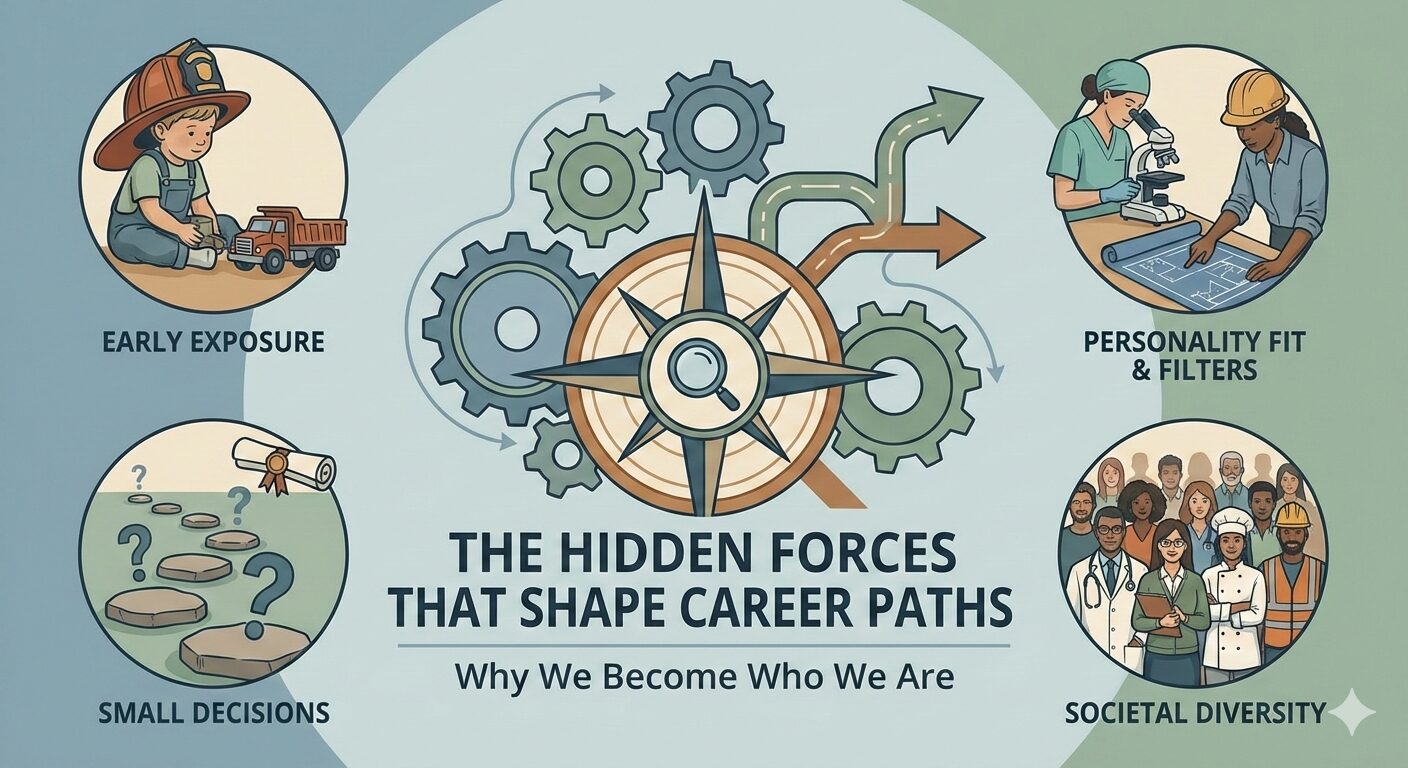
Why does one person become a firefighter, another a dentist, and another a medical resident — while millions never even consider those paths?
Career choice often feels mysterious. Some people seem “born” for their profession, while others drift into a job without ever planning it. The truth is: choosing a profession is rarely a single decision. It is the result of many hidden forces working together over time.
In this article, we’ll break down how people really end up in specific careers, and why society naturally spreads across so many professions instead of clustering into just a few.
1. Personality and Psychological Fit
Not everyone is wired the same way — and careers quietly filter people based on personality.
Some examples:
- High-risk, action-oriented personalities gravitate toward firefighting, emergency response, or the military.
- Detail-focused and precision-driven individuals often choose dentistry, surgery, or engineering.
- Empathetic and emotionally sensitive people are drawn to medicine, therapy, education, or social work.
- System thinkers and problem solvers often end up in technology, infrastructure, or data-related roles.
A key factor is stress tolerance:
- Not everyone can handle blood, pain, or life-and-death decisions.
- Not everyone can sit in front of a screen for 10 hours a day.
- Not everyone can function under constant pressure or uncertainty.
Careers naturally attract people who can survive their emotional demands.
2. Early Exposure Shapes What Feels “Possible”
Most people don’t choose from all careers — they choose from the ones they know exist.
Early exposure matters:
- Parents’ professions
- Family expectations
- Teachers and mentors
- Media, movies, and role models
A child raised around doctors often sees medicine as realistic.
Someone who never met an engineer may never consider engineering.
Many careers aren’t chosen — they are noticed at the right moment.
3. Natural Filters Eliminate Most Candidates
Even when many people want the same profession, only a few pass the filters.
Common filters include:
- Academic ability (grades, entrance exams, certifications)
- Mental endurance (long training, high responsibility)
- Financial reality (years without income, tuition costs)
- Patience and delayed gratification
For example:
- Many want to become doctors — few survive medical residency.
- Many want to work in tech — not all enjoy continuous problem-solving.
- Many like the idea of high-status jobs — fewer like the daily grind.
Careers self-select people through difficulty.
4. Careers Are Built From Small Decisions, Not Big Ones
Almost nobody wakes up one day and says:
“I will become a dentist.”
Instead, it looks like this:
- A good grade in biology
- A positive experience with a professional
- A suggestion from someone trusted
- One successful step forward
- Repeating what seems to work
Careers are paths, not destinations chosen upfront.
5. Society Requires Professional Diversity
If everyone chose the same profession, society would collapse.
We need:
- Doctors and nurses
- Firefighters and police
- Engineers and technicians
- Teachers and caregivers
- Builders, planners, operators, and maintainers
Human diversity isn’t a flaw — it’s a system feature that keeps civilization functional.
6. The Uncomfortable Truth: Most People Don’t Follow a “Calling”
A hard truth:
- Most people do not discover a life purpose.
- They find something tolerable, achievable, and sustainable.
- Meaning often comes after entering a profession, not before.
In hindsight, people tell a clean story.
In reality, most careers are shaped by chance, limits, and adaptation.
Final Thoughts: Careers Are Less About Destiny and More About Fit
People don’t choose careers because they are special —
they choose them because:
- The career fits their psychology
- They were exposed to it early enough
- They passed the filters
- They kept moving forward when others stopped
A profession is not a verdict on intelligence or value.
It’s simply where a person and a system happened to align.
SEO Keywords Used Naturally:
- how people choose a profession
- career choice psychology
- why people choose different careers
- how careers are formed
- factors influencing career decisions
- personality and career fit

Leave a Reply