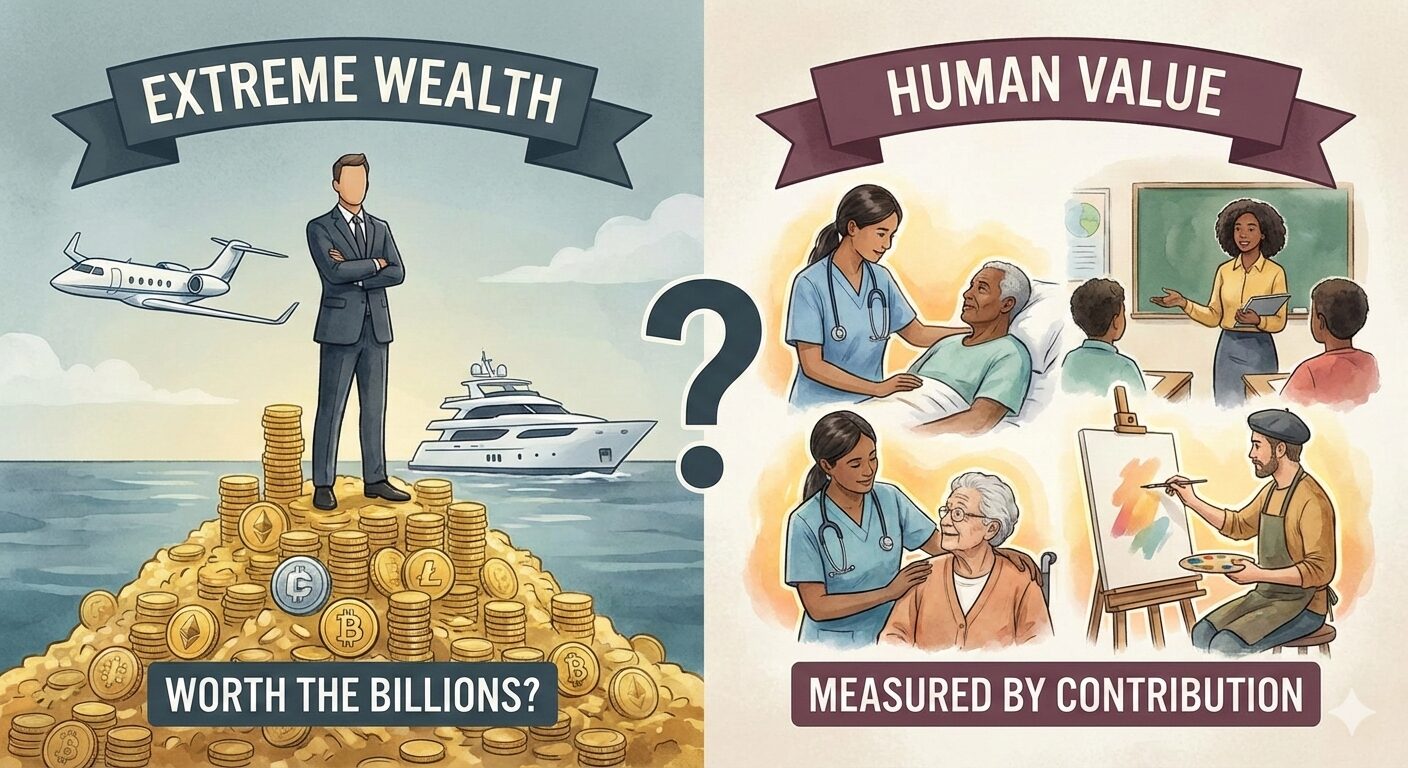
Are Billionaires Really Worth Their Billions?
A question that quietly troubles many people is deceptively simple: How can one person earn millions or billions, while another—just as intelligent, hardworking, and moral—earns very little? Are billionaires truly more talented than everyone else? Or is money itself a distorted measure of value?
Money Is Not Human Value
Wealth is often mistaken for worth. Society subtly teaches us that higher income equals higher value, intelligence, or contribution. In reality, money measures participation in a system—not human importance.
A nurse saving lives, a teacher shaping minds, or a caregiver supporting families may contribute far more to humanity than a hedge fund manager, yet earn a fraction of the income.
Wealth Is Relative, Not Absolute
Money is not a natural force like gravity. It is a shared belief system: numbers on screens, agreements, and trust. At extreme levels, wealth no longer reflects effort or productivity. It reflects position.
A billion dollars does not mean someone worked a thousand times harder than a millionaire—it means they control a point through which massive flows of money pass.
The Power of Leverage and Scale
Extreme wealth usually comes from leverage: ownership of platforms, systems, or intellectual property that scale to millions of users.
A brilliant teacher can reach 30 students at a time. A mediocre app can reach 300 million users. The market rewards scale—not depth, care, or craftsmanship.
The Role of Timing and Luck
Success stories often highlight vision and persistence, but quietly ignore timing, access, and chance. Being in the right place, at the right time, with the right connections can outweigh raw talent.
This does not invalidate success—but it challenges the myth that wealth is purely earned through merit.
Is Money a Fiction?
In a deep sense, yes. Like borders, titles, and social status, money exists because we collectively agree it does. Yet this fiction is powerful enough to shape real lives, opportunities, and suffering.
Do Billionaires Deserve Their Wealth?
Economically, within the rules of the system, the answer may be yes. Morally, the answer is far less clear. Human value cannot be quantified, owned, or accumulated.
Money reveals how a system distributes rewards—not how much a human being is worth.
The Deeper Discomfort
At its core, this question reflects a quiet realization: the world does not reward fairness, effort, or goodness in a linear way. And recognizing that truth can feel unsettling—but also freeing.
Understanding the game does not mean surrendering to it. It means choosing consciously how—and whether—you want to play.

Leave a Reply