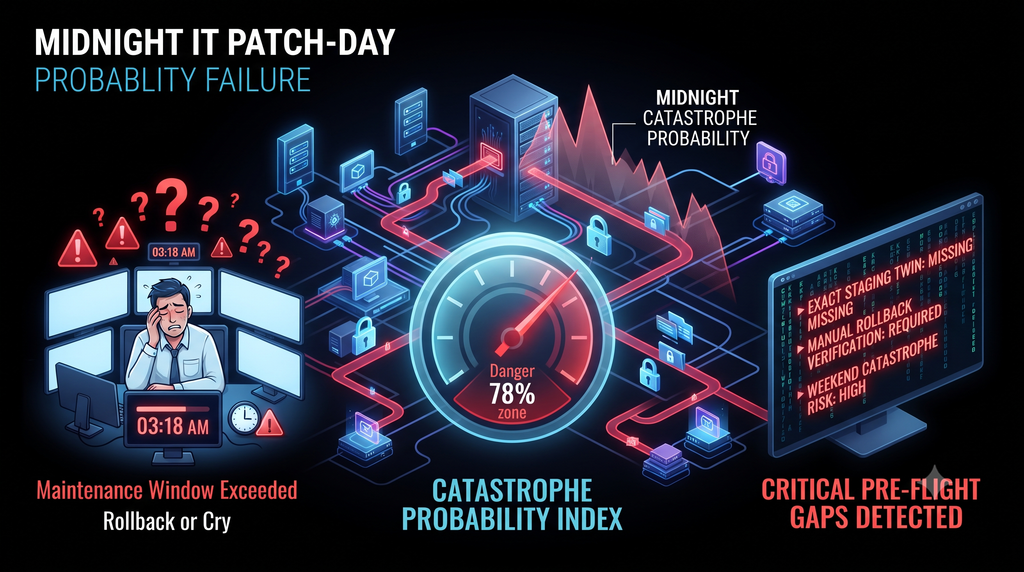
The Midnight Patch-Day Failure Risk Estimator: The ‘Rollback or Cry’ Trap
Every seasoned sysadmin knows the chilling feeling: Thursday night at 23:00, you trigger a routine cumulative security update on a critical Active Directory domain controller or core storage cluster. By 02:00, the machine enters a boot loop, network interfaces fail to initialize, and the management console is completely unresponsive.
That is when the panic sets in. You look at your watch, realize you have only two hours left before Monday morning production shifts, and wonder why your rollback plan is failing you.
The Anatomy of a Midnight Failure
Most infrastructure engineers schedule maintenance windows based on hope rather than mathematical resilience testing. Here is why patch nights turn into multi-day nightmares:
- The Staging Illusion: Testing a patch in a lightweight test lab that bears zero architectural resemblance to your high-availability production domain.
- The Snapshot Trap: Relying on hypervisor snapshots without validating database consistency, volume shadow copies, or Active Directory USN rollback protection.
- The Clock Pressure: Trying to troubleshoot obscure kernel panics or driver conflicts under extreme fatigue at 3:00 AM.
🌙 Midnight Catastrophe & Rollback Risk Estimator
Input your maintenance window and testing metrics below to calculate your true weekend disaster probability:
Patch Risk & Rollback Reality Analysis:
Conclusion & Next Steps
Safeguarding your enterprise infrastructure isn’t about avoiding patches; it’s about eliminating blind optimism, enforcing exact staging twins, and mastering zero-downtime rollback protocols before the clock strikes midnight.
Did this estimator expose terrifying gaps in your patch maintenance protocol?
Don’t wait for a midnight crash to find out. Share this interactive risk calculator with your fellow infrastructure engineers and IT leaders right now!


Leave a Reply