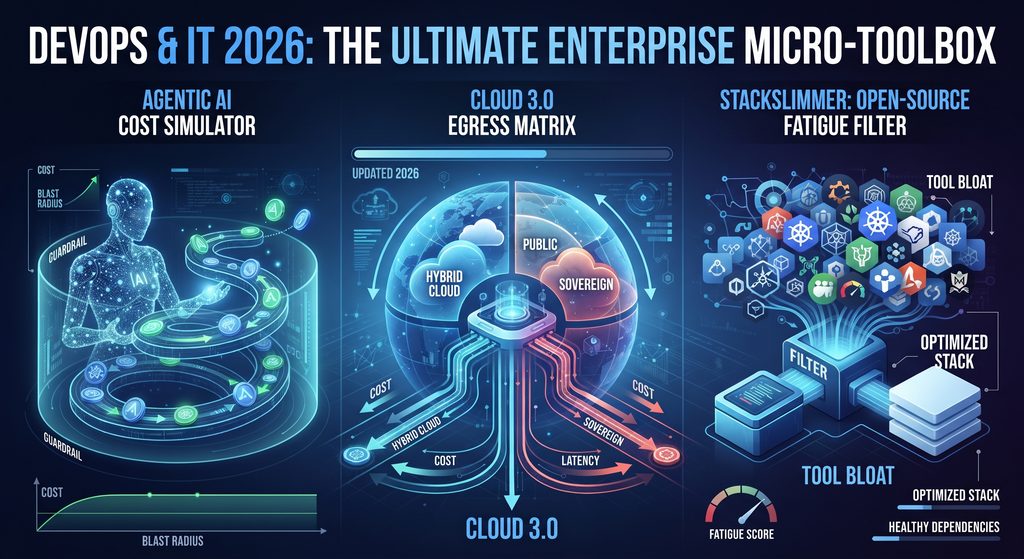
Navigating the 2026 IT Paradigm: Autonomous Agents, Cloud 3.0, and Open-Source Fatigue
As we navigate through 2026, enterprise IT has shifted dramatically from mere cloud migration to hyper-optimized autonomous operations. Yet, with these breakthroughs come severe operational hazards: runaway token consumption in Autonomous Agentic loops, catastrophic data egress bills across Sovereign Hybrid Multi-Cloud architectures, and crippling developer burnout caused by dependency bloat and “Open-Source Fatigue.”
To solve these bottlenecks instantly without complex server deployments or paid SaaS lock-ins, our infrastructure guild engineered three enterprise-grade, client-side micro-tools. Fully self-contained, offline-capable, and ready for immediate deployment in your CI/CD pipelines or incident response rooms.
AgentGuard JS
Simulate blast radius and token economics for autonomous AI agents.
CloudMesh Calc
Calculate Data Gravity & cross-region Sovereign Cloud egress costs.
StackSlimmer
Audit dependency fatigue and prune redundant CNCF stack layers.
AgentGuard JS: Agentic AI Cost & Blast-Radius Simulator
Simulate runaway loop probabilities, token burn rates, and financial risk thresholds for production AI agents.
Simulation Parameters
How to use AgentGuard JS in your Enterprise Workflow
1. Adjust sliders to reflect your current or planned fleet of autonomous troubleshooting or CI/CD AI agents.
2. Monitor the Blast Radius Index: If rated High or Critical, integrate circuit breakers and token-rate limiting per agent session.
3. Click Export Guardrail JSON to inject policy limits directly into your agent orchestration gateway.
CloudMesh Calc: Sovereign & Multi-Cloud Egress Matrix
Calculate Data Gravity gravity wells, cross-border egress penalties, and optimal hybrid-cloud routing in real-time.
Egress & Topology Settings
Architectural Recommendation Matrix
Evaluating multi-cloud traffic routing based on current bandwidth and sovereign requirements…
How to use CloudMesh Calc
1. Input your primary cloud provider and expected inter-region/cross-continent data movement in Terabytes.
2. Review the Data Gravity Score to determine if your cluster risks latency bottlenecks.
3. Export the architecture report to present cost-saving migration strategies to your cloud engineering committee.
StackSlimmer: Open-Source Fatigue & Dependency Optimizer
Paste your tech stack manifest or select standard tools to compute maintainability fatigue and prune redundant packages.
Select Active Stack Components
Recommended Pruning Actions
- Consolidate observability agents into a unified OpenTelemetry standard.
- Migrate legacy Jenkins pipelines to modular GitHub Actions / GitLab CI templates.
- Deprecate 12 orphaned internal helper packages with zero commits in 180 days.
How to use StackSlimmer
1. Select the active components in your enterprise engineering stack that cause high maintenance friction.
2. Review the Fatigue Index Score to quantify developer burnout and cognitive load.
3. Export the optimization JSON and share the recommended pruning actions with your principal architects.

Leave a Reply