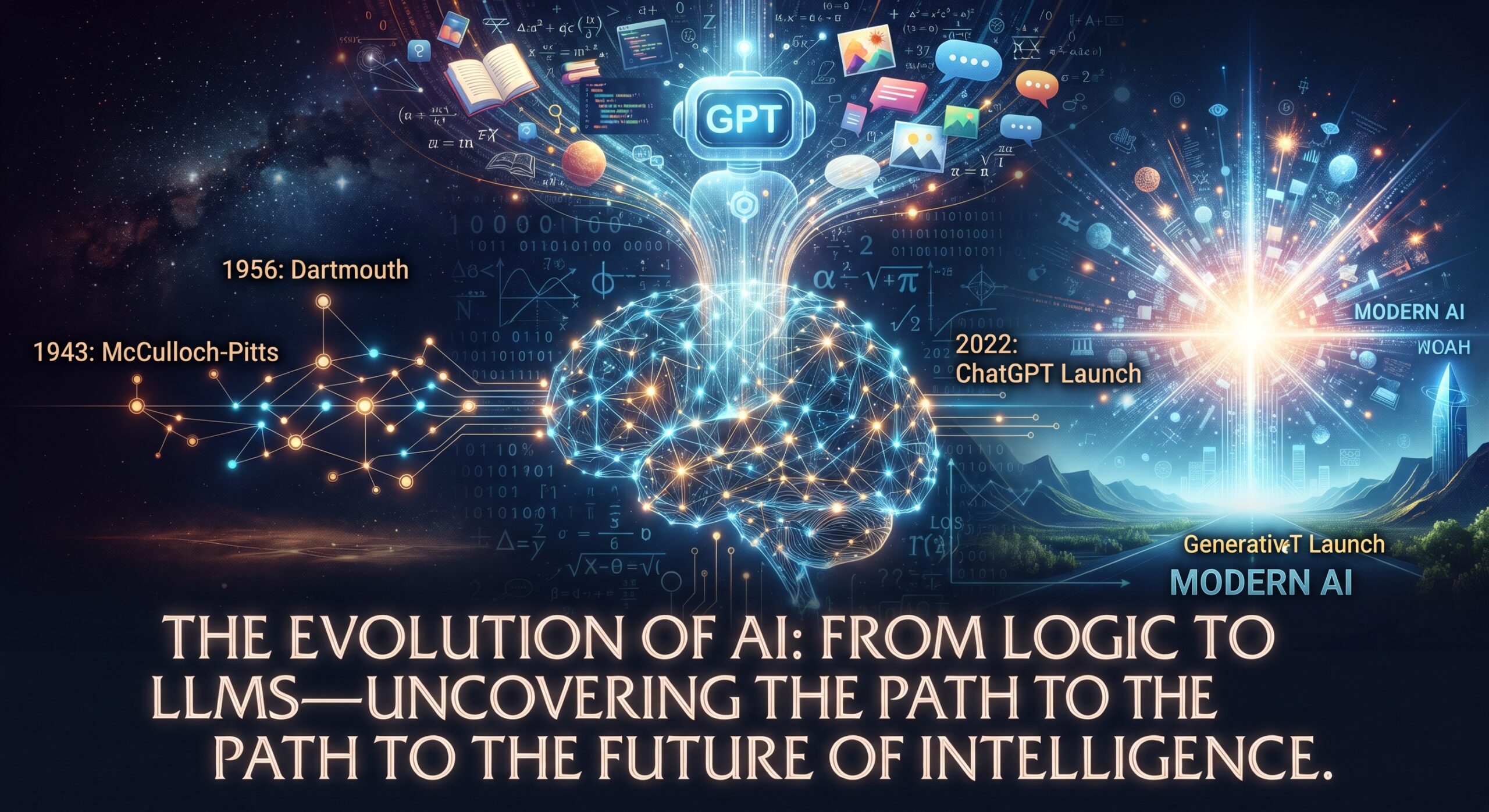
The Complete History & Mechanics of Artificial Intelligence
From the 1943 McCulloch-Pitts neural model and Alan Turing’s groundbreaking tests to the devastating AI Winters, the Backpropagation breakthrough, and today’s Generative AI explosion.
The Genesis: Mathematical Foundations & The Birth of AI (1943–1956)
Long before modern GPUs rendered hyper-realistic images or large language models composed essays, artificial intelligence began as a bold philosophical and mathematical quest. Scientists wondered: Can we replicate biological thought using strict mathematical logic?
McCulloch-Pitts Neural Model
Neurophysiologist Warren McCulloch and mathematician Walter Pitts published a paper proving that simplified artificial neurons could perform logical operations (AND, OR, NOT). This was the foundational spark connecting biological brains to digital computation.
Alan Turing & The Turing Test
Computing pioneer Alan Turing published “Computing Machinery and Intelligence”, replacing the metaphysical question “Can machines think?” with an empirical benchmark: Can a machine converse indistinguishably from a human?
The Dartmouth Workshop (Summer 1956): Birth of the Name
Organized by John McCarthy, Marvin Minsky, Claude Shannon, and Nathaniel Rochester, the Dartmouth Summer Research Project on Artificial Intelligence officially coined the term “Artificial Intelligence.” Their optimistic proposal stated: “Every aspect of learning or any other feature of intelligence can in principle be so precisely described that a machine can be made to simulate it.”
The First AI Software: The Logic Theorist (1955–1956)
Built by Allen Newell, Herbert Simon, and Cliff Shaw, The Logic Theorist was the world’s first functioning AI program. It proved mathematical theorems from Russell and Whitehead’s Principia Mathematica—even inventing cleaner proofs than human mathematicians in several instances.
The Great Freezes: Why Did AI Winters Happen?
History reveals that AI progress has not been linear. Over-promising by researchers led to massive funding cuts, corporate collapses, and decades of scientific stagnation known as “AI Winters.”
1. The First AI Winter (Mid-1970s to Early 1980s)
Combinatorial ExplosionEarly programs worked fine in toy puzzles but failed drastically in the real world. As researchers attempted to scale translation or reasoning, the number of possible states grew exponentially (combinatorial explosion), choking primitive computers.
The Lighthill Report (1973): Commissioned by the British government, Sir James Lighthill published a scathing evaluation concluding that AI had failed to meet its grand grandiose promises, leading Britain and the US to slash research grants.
2. The Second AI Winter (Late 1980s to Mid-1990s)
Expert Systems CollapseIn the 1980s, “Expert Systems” (hardcoded rule engines like MYCIN) flooded corporate budgets. However, maintaining hundreds of thousands of rigid “If-Then” rules became unmanageable. When rules conflicted, systems failed catastrophically.
Simultaneously, cheap, powerful desktop PCs (Apple and IBM) made expensive dedicated Lisp machines obsolete. Companies that invested billions in AI went bankrupt, and investors retreated for nearly a decade.
The Renaissance: Deep Learning & The Shift to Data-Driven AI
The fundamental paradigm shift that revived AI was abandoning rigid human-written rules in favor of machine learning from data. Instead of programming what a cat looks like, researchers fed networks millions of cat photos.
The explosive rise of the internet provided digital oceans of text, images, and videos to train neural networks.
Graphics processing units (GPUs), originally built for video games, proved thousands of times faster at parallel matrix math.
Stacking dozens of hidden layers allowed neural nets to extract complex hierarchical features (edges → shapes → faces).
How Backpropagation Works: The Engine of Neural Learning
How do neural networks actually learn? The secret lies in Backpropagation (Backward Propagation of Errors) coupled with optimization algorithms like Gradient Descent. Think of it as a rigorous private tutor correcting a student’s exam.
Forward Pass & Loss Function
Uninitiated weights make a wild guess (e.g., predicting an 80% chance a dog photo is a cat). A mathematical Loss Function measures the exact magnitude of the error by comparing the prediction to reality.
Backward Pass & Weight Updates
Using calculus (chain rule), the network traces backward from the output layer to assign blame to specific neurons. An optimizer (Gradient Descent) tweaks the weights—strengthening correct pathways and weakening faulty ones.
// Conceptual Gradient Descent loopwhile (total_loss > threshold) { predictions = forward_pass(training_data); loss = calculate_loss(predictions, actuals); gradients = backpropagation(loss); weights = update_weights(weights, gradients, learning_rate);}
The November 2022 Turning Point: The ChatGPT & LLM Revolution
Why did AI suddenly explode into public consciousness just a few years ago? While tech giants held advanced models in labs, OpenAI’s release of ChatGPT in November 2022 democratized artificial intelligence overnight.
No coding or complex commands required. Users simply chatted in natural human language, matching human conversational nuances instantly.
Powered by massive Large Language Models (LLMs) utilizing attention mechanisms to predict the next logical token with unprecedented contextual awareness.
Reaching 100 million users in under 5 months, it became the fastest-adopted consumer technology in history, forcing a global tech race.
AI Historical Quiz & Neural Simulator
Test your mastery of AI history and mechanics, or simulate a backpropagation training iteration right in your browser!
What was the significance of the Dartmouth Workshop in 1956?
Enjoyed this deep dive? Bookmark this page or share it with fellow tech enthusiasts!



Leave a Reply