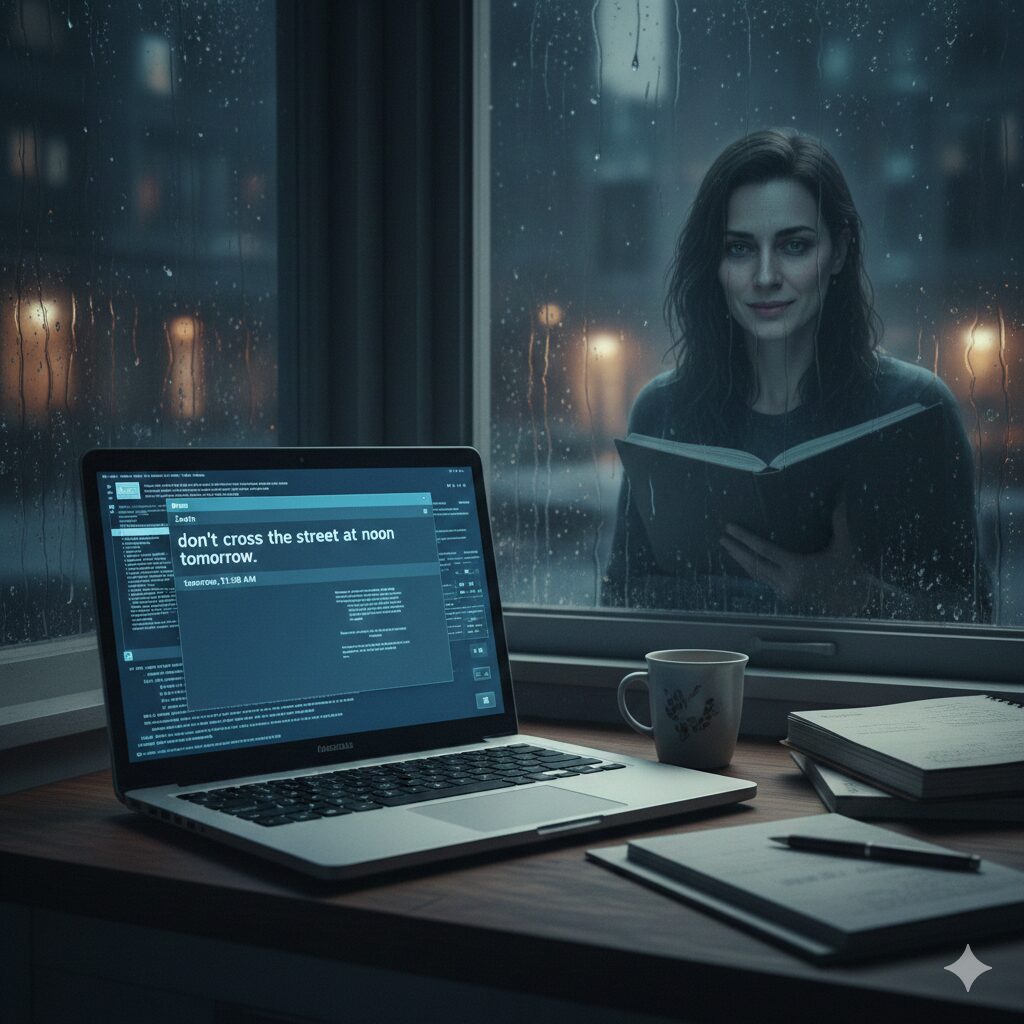
Emma’s laptop lived in the corner of her kitchen like a patient animal. She wrote ad copy by day and grocery lists by night; the Drafts folder on her email was a thicket of half-formed subject lines, joke replies never sent, and paragraphs she told herself she’d come back to.
One rainy Tuesday she opened mail she hadn’t planned to check. A new message sat at the top of her inbox with no sender, no subject — only a single line in the preview: don’t cross the street at noon tomorrow. When she clicked it, the body was empty. The headers were minimal, but the message showed up in her Drafts, not in Inbox. The timestamp read tomorrow, 11:58 AM.
She assumed a glitch. She shrugged it off and poured coffee. Two minutes to noon the next day, she stood at the curb with her umbrella and, for reasons she could not explain, she waited. At 12:03, a truck barreled through a red light where she would have been crossing. The driver later said his brakes failed. If she’d left at noon, she would not be typing this now.
After that, the Drafts folder became a map.
Messages appeared there every few days. They never came from a name she recognized. There were no signatures. Each was a three- to eight-word instruction typed in a bare font, always showing a timestamp thirty minutes to two hours in the future. Don’t answer the door. Turn left at the bakery. Take the job offer. They were precise, intimate in a way that suggested someone watched more than the street — someone watched her.
Emma tried to outsmart them. Once she timed herself, leaving the house earlier, later, waiting for the message to appear. The Drafts always arrived as if impatient with her timing, and the instructions always worked. She stopped taking small risks; she stopped staying out late. Her life shrank into a ragged circle around the laptop.
Curiosity gnawed a hole in her. She forwarded one of the draft messages to a friend. The forward vanished from the Sent folder before the friend even opened it. When she tried to show proof, the draft disappeared from view as if untyped. Only her memory held the text.
She tried to trace origins: IP addresses, headers, the server route. Nothing. The message metadata was surgical and untraceable. The timestamps, however, were precise to the minute.
Then a draft arrived that was different. It was longer, dated two weeks ahead. The subject line was: If you read this, you choose. She almost closed it, but curiosity was an animal that had learned how to claw. The body said:
Tonight, the man with the gray scarf will smile at you on the train. Speak his name and you will change something that cannot be put back. Do not reply. Do not save a copy. If you do, the drafts will know you know. Choose one: ignore him, or speak and accept the transfer.
The phrase accept the transfer felt wrong in a way she couldn’t name. Still: a stranger smiled and the song of the subway track hummed. At the stop the man in the gray scarf did smile. Emma kept her head down and ignored him. The train blurred by.
When she reached home, another draft had arrived: You chose. Watch for the small ledger. Underneath, a short list of three places: a bench outside the post office, locker B12 at the gym, and a digital note in her own Drafts named ledger.txt.
She opened ledger.txt and found a table — names, dates, and a narrow column labeled STATUS. Her name wasn’t there. The three places listed contained objects: a coin under the bench with the digits 4–2 etched on one side; a strip of tape in locker B12 with a numeric code; and the ledger.txt draft now contained a new line with another name she recognized from childhood — someone who had moved away and whose social media had gone quiet. The status beside that name read SENT.
Panic curled cold fingers around her throat. She typed the name into search windows and found absolutely nothing — a blank trail of absence. No posts, no public records rearranged; that person simply existed in memory, in private messages friends recalled, but in the public measure of presence they were hollow. The draft had moved a fact from being public to being… elsewhere.
One night she opened a draft with a future timestamp and found a paragraph written in a voice that sounded like her own. It described the way her hands would shake when she opened the wardrobe, the exact pattern of worn thread on the sleeve of the gray scarf. It ended with a line she couldn’t swallow:
This is how it shifts: you write, you send, you become the holder. The drafts find bearers. They do not let the ledger go empty.
Emma saved a copy to her desktop.

She awoke the next day to find the copy gone. In its place, a fresh draft: You saved a copy. That was your last clean thing.
She stopped sleeping properly. She stopped telling people things. Her world narrowed to caution and the glow of a screen. The Drafts folder was no longer passive; it was a machine that used language as a hinge.
On a rainy Thursday, a draft arrived that bled into her chest like cold water. Subject: YOUR NAME — TRANSFER WINDOW 17:00. The body had a single paragraph detailing the mechanics of a ritual—simple, bureaucratic, obscene: open your Drafts at 17:00, select the oldest unsent message, forward it to the sender address that will appear, then close the browser and wait. The last line read: If you do not forward, someone else will be chosen. If you forward, you inherit the ledger.
Emma stared at the clock. 16:58. She could have left. She could have burned the laptop, thrown it into the sink, run away. Instead she thought of lives blurred into absence and of the man with the gray scarf — an incidental exchange that felt like a hinge. She thought of the ledger.txt and the empty column that must be filled someday.
At 17:00, a new draft notification pinged. A sender address scrolled into the header — a string of characters that resolved to nothing when she hovered it. Her cursor trembled. She opened the oldest unsent draft (a grocery list she’d forgotten), hit forward, and for a heartbeat nothing happened. Then the email client froze, and a new window popped: a single form field asking her to type her full name. Beneath it: I ACCEPT — a dim, clicking button.
Her hands hovered. Emma thought of the truck’s brakes and red lights and the man’s polite smile. She thought of the ledger’s blank column. The drafts had saved people from accidents and moved them out of files; what were they saving them into?
She clicked I ACCEPT.
The screen pulsed; the cursor blinked once and then stopped. The ledger.txt draft, which had sat open in the background, updated itself with her name and the time. A new column appeared: HOLDER. Where other names had once been marked SENT, hers read ACTIVE.
Emma’s phone buzzed. She looked at the notification and saw three messages: Don’t panic, Hold your breath, Find the mirror by the window. When she went to the window, the mirror leaned against the sill, though she had never owned a mirror like that. When she lifted it, she felt the world press in — memory, like cotton. She glanced at her reflection and for a moment she saw another Emma behind her eyes: pale, steady, with the same tiredness but with a ledger of her own in hand.
She tried to speak.
Her voice echoed oddly, as if delayed. The drafts had a sound all their own now — a faint mechanical whisper behind every unsent message, a hum like a bee trapped in glass.
A new draft arrived with one line: To pass the ledger you must be quiet. Speak the names and you will be undone. Another line scrolled beneath it and froze: A holder’s life exists in two places. Carefully.
Emma closed the laptop and tried to stand. Her legs felt both hers and not. Her memory ached with other people’s small vanishings. She felt the ledger in her hands — an abstract weight she could not set down.
Days later, friends called. Some remembered she had been at work; others recalled sudden administrative notes about her position being reclassified. Her social profiles still worked but felt thin. A rumor spread in her office that Emma “had taken leave.” In private, everyone who loved her remembered full conversations, laughter, the smell of her coffee — but the public record began to acquiesce to the ledger’s shape: posts archived, her name omitted from minutes, a photograph gradually fading at the edges.
The Drafts continued. They still saved people from accidents — but being saved had a cost. The ledger needed holders. Someone had to watch the edge between public and private, and the mechanism demanded a guardian who could not speak the names aloud.
Emma learned the rules the way a child learns rules for crossing streets: memorize, perform, and do not test.
In the ledger, a last line appeared under her name: HOLDER — TEMPORARY. She blinked, a human reflex, and for a moment felt entirely present. The draft machine hummed and the oldest unsent message in her Drafts glowed, waiting for a new hand to forward it.
On a rainy morning much like the one when the first draft had appeared, a plain message arrived in an empty mailbox of a new inbox. The header was blank. The body read, simply: Do not cross the street at noon tomorrow.
And somewhere, in a small kitchen, Emma’s fingers hovered over a new draft, writing in a voice she recognized as the only one that could hold and feed the ledger:
don’t cross the street at noon tomorrow.
She hit save. The draft slipped into the unsent list with no sender, no signature. She locked the laptop and set it in the corner of her kitchen like a patient animal.
Her reflection in the window smiled the way someone smiles when they keep a promise to a thing that cannot be thanked.

Leave a Reply