
They say the shutter remembers longer than the eye. Tomas believed that until the shutter began keeping things he had not meant to give.
He bought the camera at a sleepy auction the summer after his wife left — a brass-bodied thing with a bellows that smelled faintly of coal and chewing tobacco. The seller called it an “orphan plate” and winked, as if that explained anything. Tomas liked the weight of it in his hands, liked how the viewfinder folded the world down to a single, honest frame. He used it to take simple things at first: a market stall, a cat caught mid-leap, the steam off a coffee cup. He printed them in his basement darkroom, the chemicals steaming like secrets. The pictures were clean and a little cruel in the way film is.
The fourth time he photographed her — his daughter, sleeping on a summer visit, the light like flour across her hair — something about the negative trembled. When he developed it, the image was not merely still: it held a tiny pulse, a suggestion of motion, like a blink trapped between frames. Strangest of all, the light in her pupils seemed articulate, attentive as if they heard him. He told himself that was nostalgia, the film’s chemistry playing tricks on a man who missed another man’s laugh at the top of the stairs.
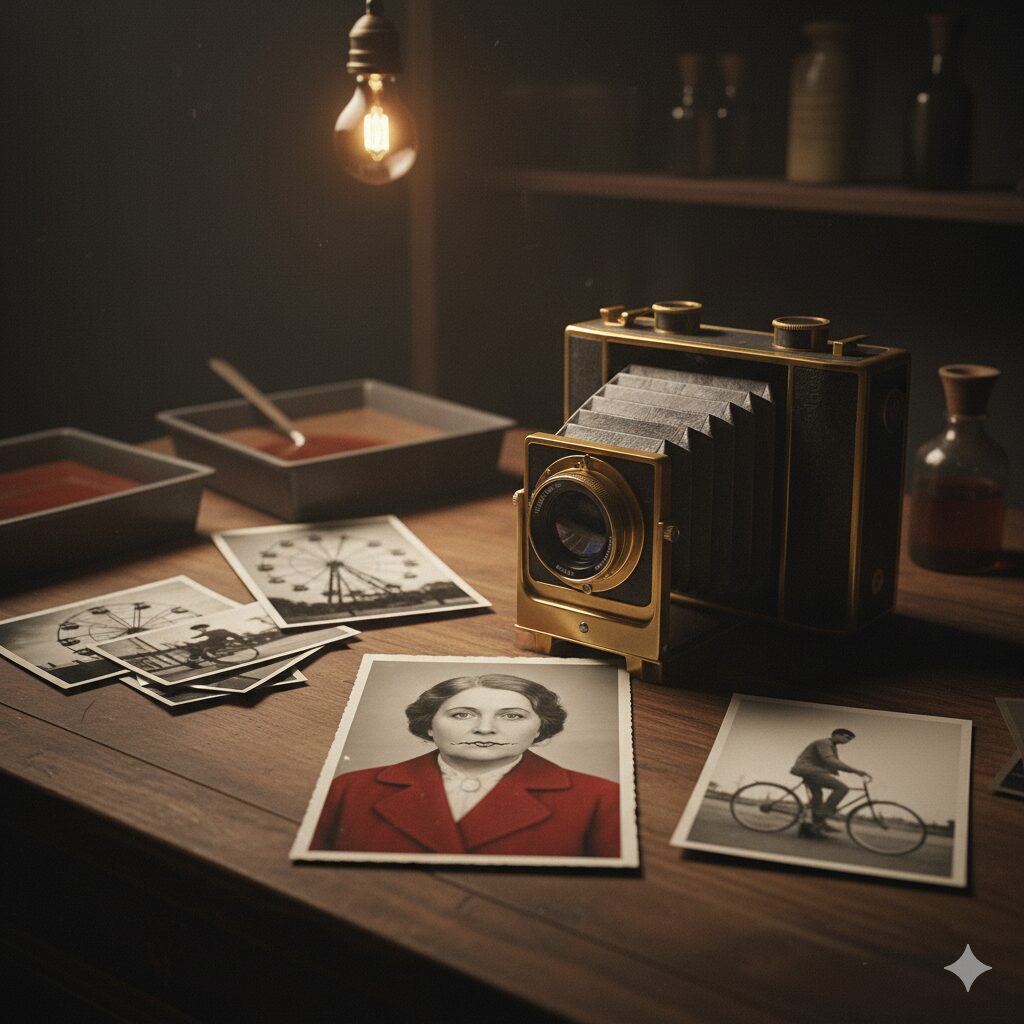
Sales picked up after the photographs of the town ferris wheel circulated. People came with birthdays and weddings and half-remembered pets. Tomas learned how to coax a face to truth. He learned to ask, softly, the question that made a person’s jaw relax: “Look at the place you almost went.” It was a trick; everyone has a place they almost go, a choice they almost made. The camera caught that pause and turned it into light.
Then the fifth person came — the woman in the red coat from the bakery who bought his prints. She wanted a portrait “to show the grandchildren.” He set her on the chair, asked the almost-go question, felt the small scale of her life skitter open like a drawer. He lined up the shot and pressed the shutter.
When he developed that negative, the chemistry did not merely fix the silver. The paper showed a tight, living seam across the woman’s mouth, as if some other thing tried quietly to keep it shut. Her eyes in the print looked at him with accusatory warmth. He felt watched by something that tasted like memory. That night he dreamed he was walking through the town and all the framed photographs in shop windows blinked back at him, lips moving with their mouths shut.
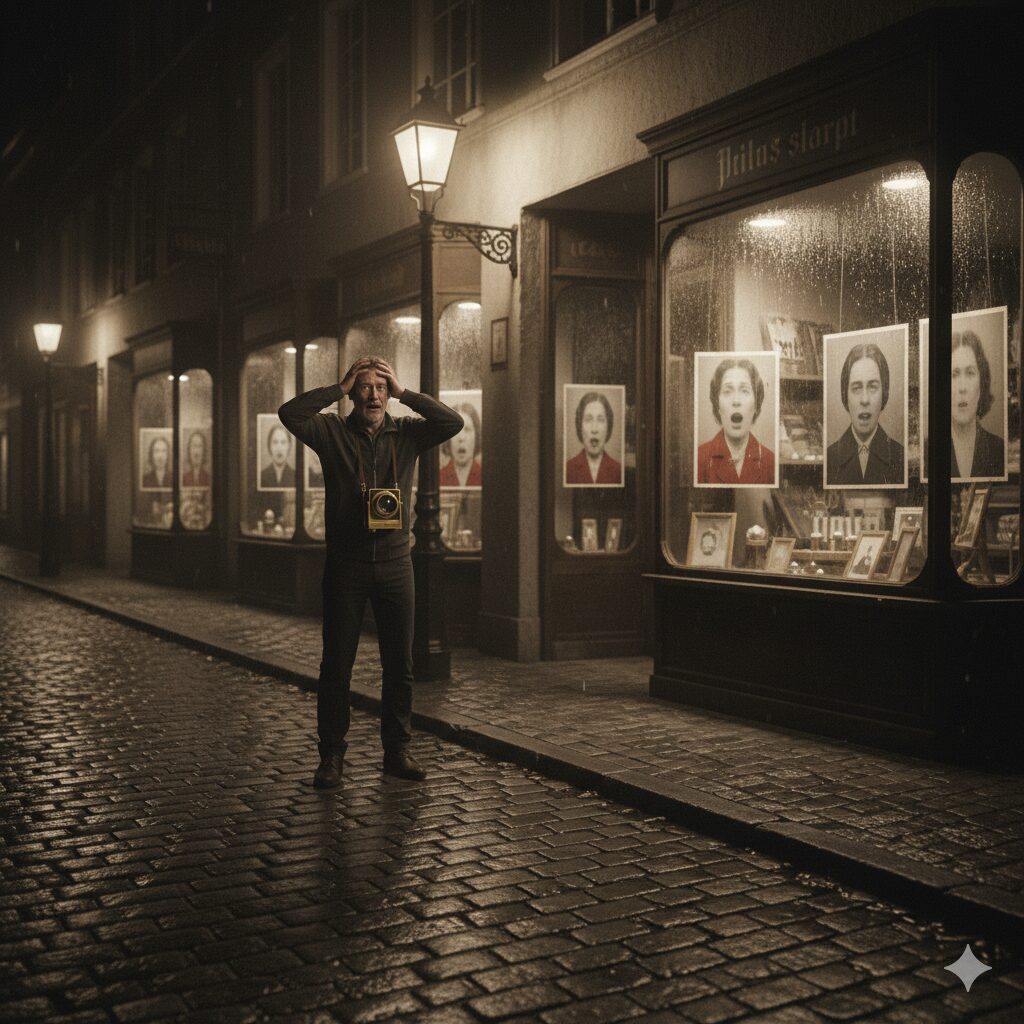
He began to notice absences.
The baker’s son stopped coming to work; his bicycle stood rusting against the fence, locked. The man who sold shoe polish found himself misplacing the same watch every day — then forgetting the watch existed at all. The woman in the red coat did not come back to collect her portrait. She forgot having ever wanted grandchildren. When Tomas knocked on her door weeks later, she smiled politely, then told him, as if stating the weather, that she did not like photographs.
Guilt is a heavy shutter. Tomas tried to stop. He put the camera in a drawer wrapped in cloth and tape. He burned the last roll in the yard. But the thing inside the bellows wagged, impatient and hungry. The town’s life had thin points: the hesitation before a confession, the small place someone almost went. The camera liked those thin points because they bent time into something it could hold. Each portrait that turned a pause into a perfect frame left behind a sliver of the future — not much, a week here, a memory there — until the person wore a hole where that sliver had been. Holes, Tomas realized, do not close; they grow quiet and then vanish.
He tried to refuse the people who kept coming — to knock on wood, to say he had taken up gardening, to move away. They brought their children and their last living pets and their sainted great-uncle’s hats and the camera made its small soft theft. Some mornings the town seemed to breathe easier; some nights it went to bed heavier, full of a small, sticky sorrow no one could name.
By the time his daughter came to visit again, the camera had eaten five small futures. She laughed across the table and told a joke whose cadence he could feel ticking like a clock. Tomas found himself arranging the old brass camera on the windowsill by habit, as if its dark lens were a talisman. He swore he would not — and then, while she made coffee, he lifted it, peered through the viewfinder and whispered the question like a prayer: “Where did you almost go?”
She blinked at him the way a child blinks at a magician and smiled, saying the name of a city he had never wanted to hear. He pressed the shutter, a tiny, polite sound. The photograph dried in the tray and her eyes in the paper were all memory and accusation. That night she forgot the city. She forgot, later, what color her favorite sweater had been. A week after that she called from a hospital three towns away; she had fallen down the stairs in the dark and could not say why she had been there. The doctors said accident. Tomas pressed his palms to his face and realized the accident wore his fingerprints.
He could have burned the camera then, smashed it with a hammer, dropped it into a river. Instead he took the negatives to the river and watched the water eat their emulsion and felt, in the way riverwater finally soaks through clothes, that he had only lightened his conscience. The holes remained.
In the dark of the basement, the camera sat unwrapped again at last. The mechanism hummed when he opened the drawer, as if it had been sleeping but not idle. Tomas was full of a dull, animal idea: that if he photographed himself — captured the hesitation that defined him — he could close the ledger. He would take his own pause and frame it, freeze the problem where he could manipulate it on the table. He set a plate in the tray, focused the lens on the line of his own throat where his pulse showed, and asked himself the question he had used on others: “What did you almost do?”
He remembered a road not taken, a letter he never sent. He let the shutter hold that ache and then, in a moment of terrible hope, he hoped the camera would restore what it had taken.
In the darkroom he developed his self-portrait as if unwrapping a confession. The print came alive under the red light: Tomas, palms white, eyes bright with the aftertaste of regret. For the first time since the camera’s bellows had tightened, he saw something else in the photograph — a shape beneath his collar, faint as underpainting, the silhouette of a town with gaps in its streets. He watched his own mouth in the print form one last movement, and the movement spelled not apology but instruction.
He had been thinking of a finish, a absolution. The photograph did not grant absolution. It offered continuity.
He put the print in his pocket and walked to the river. Wind tugged at the paper like a small urgent hand. The camera leaned on the windowsill, patient and brass, and when he glanced over his shoulder he thought the lens blinked.
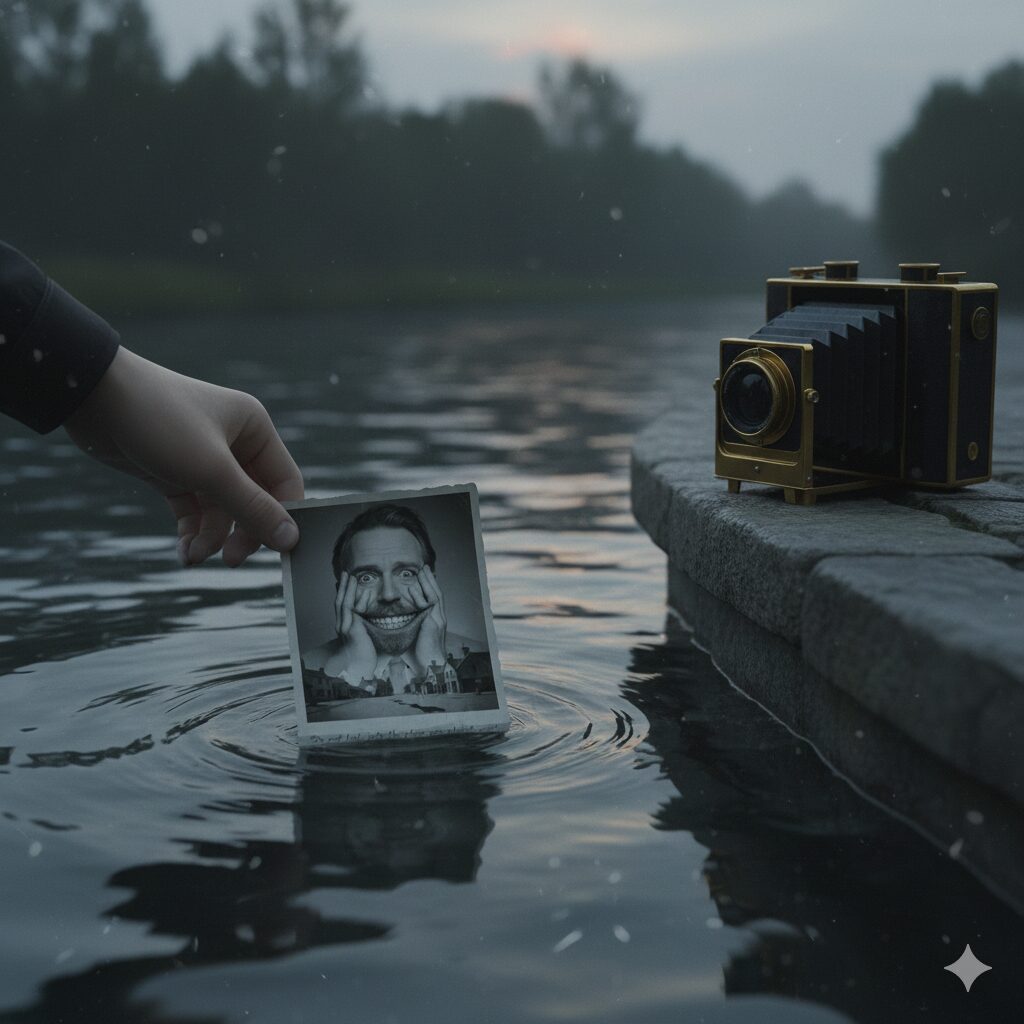
At the riverbank, he told himself he would show the photograph to the water, that the current could swallow more than negatives — that it could swallow guilt. He set the image on the surface and watched. The paper floated like a small boat, the print peering up at him with its living eyes.
And then the photograph smiled.
It was not a smile of likeness. It was the exact curve of a mouth that had learned small deceits and large kindnesses, a smile that had practiced grief until it could perform it as an art. Tomas felt, with a clarity that made his knees go brittle, that from the surface of the image a pressure pushed — a pressure like breath, a pressure like wanting. The water did not take the photograph. Instead, in one smooth, terrible motion, the paper folded upwards and passed through the film as if the emulsion were skin.
Tomas did not scream. He felt himself unmake from the heels up, like a scarf being untied. The river took his weight and left the world clean of him in the way a house is cleaned when it has been left empty long enough. His last sensation was not cold but a curious lightness, as if he had become a thing that could be kept in an album and still think.
After, from somewhere behind glass, he watched the town reknit itself. Missing watches reappeared in drawers. The baker’s son rode his bicycle again, smiling without quite knowing why. His daughter remembered the city. People hummed absent tunes where melancholy used to sit. The camera sat on the windowsill and was beautiful, and in its lens something moved like an eye pleased with itself.
Someone knocked on his door days later. A young couple wanted a portrait for an anniversary. Tomas — or rather the small, thin thing that had slid into the emulsion — found he could not move his feet. He felt everything that the photograph had felt: taste, hearing, a small longing for daylight. He wanted, with an ache sharpened into clarity, to warn them.
So he let the album edge fall open on the table and waited until the moment the woman in the couple smiled the way people smile when they think of grandchildren. He felt the shutter’s little neat want and the echo of every pause it had swallowed. He could not make his palms close, but he could make the paper tremble.
On the back of the fifth photograph — the one he had carried to the river and had been taken by — someone had written a single sentence in his handwriting while his hands were still working, while he was still human enough to hold a pen. He had the stupid hope the water might carry the message where his voice no longer could.
The sentence read: Do not look into the place you almost went.
He watched the couple as they left. He watched his daughter return, whole, and laugh. He watched the town grow kind and dull in equal measure. He watched, patient as emulsion, as his own eyes in the print learned new things.
Finally, a reader found the photograph at a flea market, took it home, and read the sentence. Curiosity is always a lighter than guilt. Fingers tremble at the same temperature as decision.
If this story reaches you as a voice in your ear or a photograph on a shelf, know this: the camera keeps what you almost do. It does not know malice; it knows completion. And when a picture smiles, that smile is not for you. It is for the thing inside the shutter, for the terrible tidy hunger of finished things.
Sometimes, when a print wants company, it writes in the margins. Sometimes it even learns to tell stories.
Sometimes, if you look too long at a photograph, you will feel the small pressure of a world trying to fit through paper.
#HorrorStory #OriginalHorror #TwistedEnding #CreepyTale #DarkFiction #UniqueStory #ChillingRead #SupernaturalMystery #UnexpectedTwist #NightmareFuel

Leave a Reply