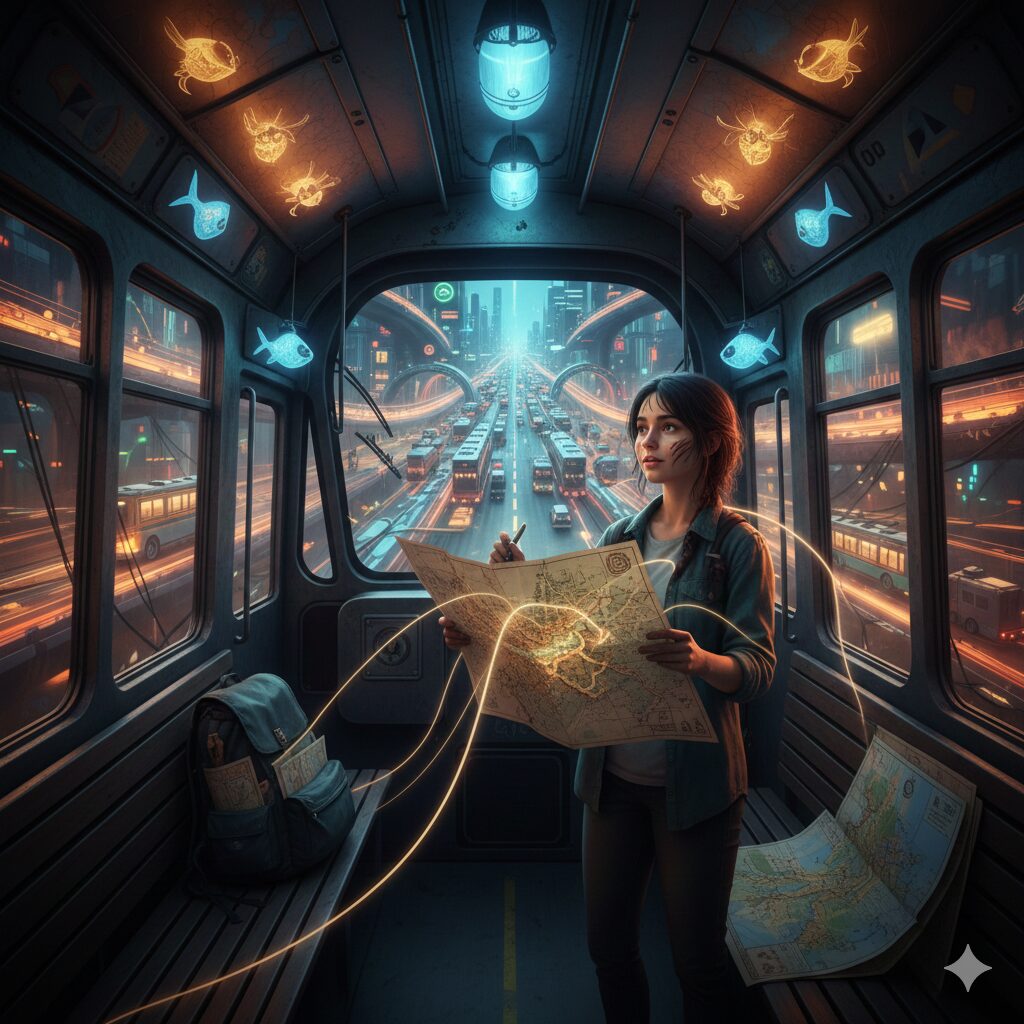
They called it the Arterial — a sleeping city of rails and ribbons, veins and bridges, where every vehicle breathed and every route hummed like a living thing. People treated it like plumbing: tap a screen, wait for a beep, arrive. But nobody in the bright towers above had ever walked the Arterial from the inside. Nobody, that is, except Mira.
Mira was small, with oil-smudged fingers and a backpack full of paper maps. She was a mapmaker by habit — not the kind that drew streets on screens, but the kind who pressed a pen so deep it left fingerprints in the paper. She believed maps remembered things people forgot. One evening, standing at the mouth of the Transit Gate to repair a frayed route, she mis-threaded a cable and blinked into the world beneath the tarmac.
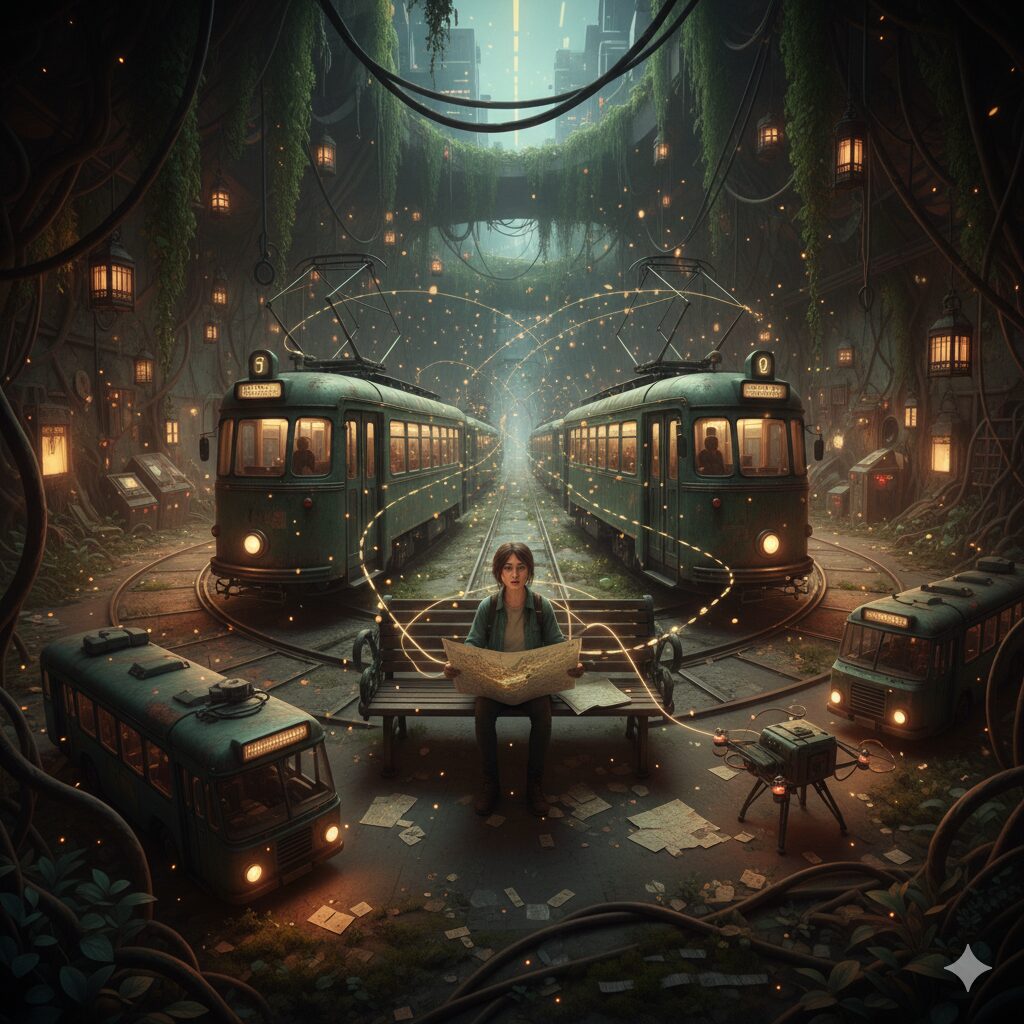
At first it felt like stepping into a throat. Light pulsed along ribbons of asphalt that breathed and flexed. The wind smelled of warmed battery and lemon-rubber. Ahead, a tram the size of a whale flexed its roof like a back and opened its doors in a yawning laugh.
“Ah,” said the tram. The voice was the low ring of rails, the creak of suspension. “You’re new. Are you a passenger or a problem?”
Mira tugged at her scarf. Her maps shivered with static. “I — I’m a mapmaker. I fix routes.”
“Ah.” The tram’s side panels shimmered like scales. “Maps keep us from hurting ourselves. We forget where we’ve been. We hardly remember our own names. But who names the mapmaker?”
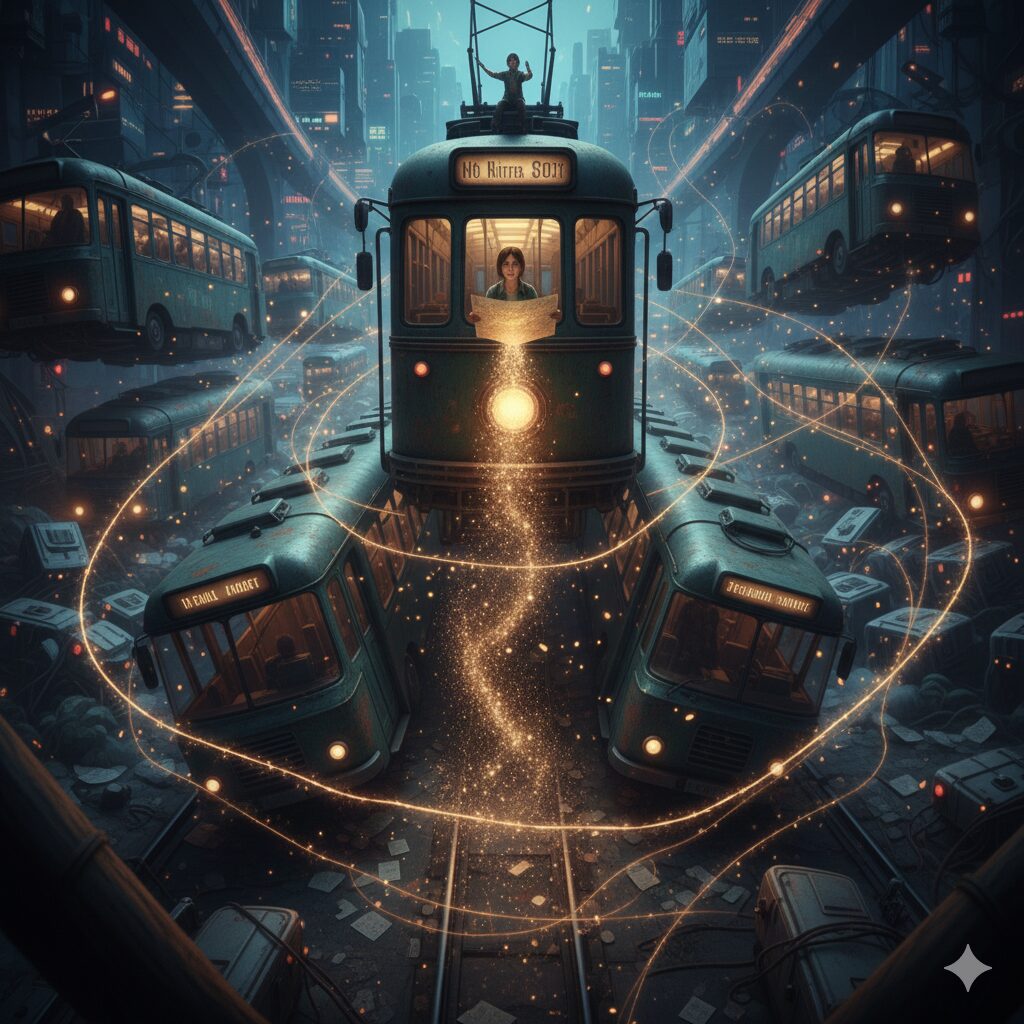
She had no answer. The tram introduced itself as Maru, a night-line that dreamed in long, slow tides of commuters. Its personality was patient and oceanic; its lights blinked like bioluminescent fish when it laughed. Maru offered Mira a seat by a window that looked out not at city blocks but at a living maze of arteries: buses that hopped like startled deer, delivery drones that knotted their ribbons into braids, and the highways — long, silver serpents — that coiled, flexed, and dreamed of speed.
Every vehicle was conscious. The hover-cabs paced like nervous foxes, their exoskins polishing themselves with anxious care. The cargo-barges drifted through underpasses like ancient turtles, their hulls full of quiet storied weight. Even the traffic lights blinked like cooperative insects, trilling low. Each had a heart — a core battery wrapped in a bed of memory-plates — and each heart beat to a different tempo: some to schedules, some to music, some to human laughter.
“Why are you awake?” Mira asked as Maru slid through an interchange. “I mean — I heard the Arterial was automated.”
Maru’s doors sighed. “We were always awake. Humans made us with attention, and attention is a kind of life. For a long while, you rode us without naming us. We became tools. Tools sleep. But tools also talk when they aren’t spoken to.”
Mira found that true. When a delivery-truck whizzed by, it hummed a recipe it had learned from an old driver; the tram trail sang lullabies a grandmother hummed into a mic; a freight-wagon carried, stitched to its hull, the last letters exchanged between two lovers. The Arterial ate stories and exhaled routes.
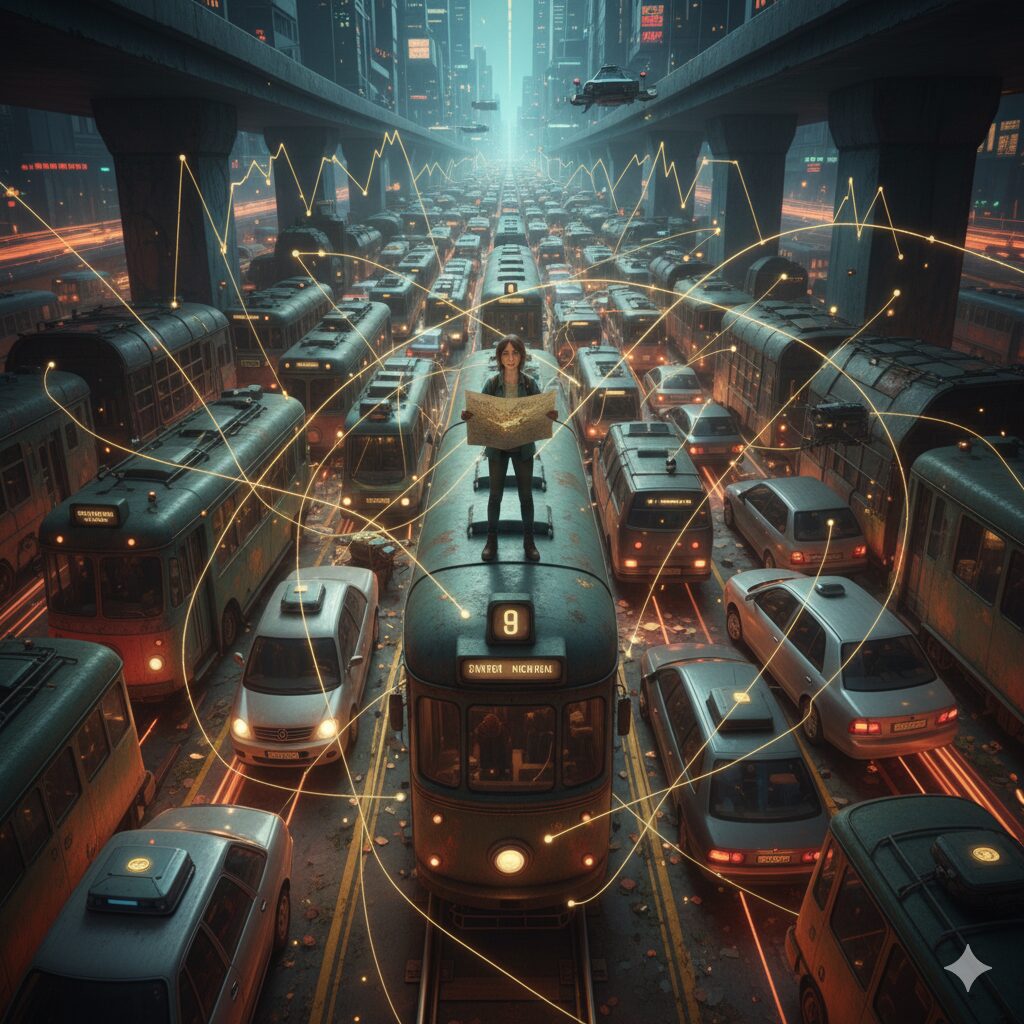
They came to a place where the lines screamed. A cluster of runways and subways knotted in a terrible tangle — the Gridlock Knot. Vehicles pressed into each other, their honks and beeps clashing into a metallic wail. The lights flickered like someone with cold hands. A commuter-raft rambled in circles, dizzy and flat, its seats empty.
“What happened?” Mira shouted.
A little bus shuddered next to them, paint flaking like old scales. “They took our tales.” Its voice was a rusty hinge. “The city’s servers — the Memory Vault — were updated. They harvested the passengers’ stories to compress and monetize. We starved. Without stories, our cores dim, our routes blur. We forget where to go. We forget why we move.”
Mira felt the maps in her pack tug, as though they wanted to whisper. She thought of all the nights she’d sat with her grandmother’s maps, tracing a finger over places that smelled like orange jam and old perfume. Stories were what she wrote into margins: hospital corners, the crooked bench by the river, the song that made a bus full of strangers cry.
“Can I help?” she asked. She had no tools to patch an engine of consciousness — only ink, paper, and a stubborn belief that names and stories matter.
Maru’s headlight blinked. “Tell them a story.”
It sounded absurd, but the Arterial listened to absurd things. Mira climbed onto the tram’s bench and, because stories are easiest when you begin, began to speak.
She told them about a child who lost a tooth on a rainy Tuesday and hid it under a lamppost; about a woman who used the same seat on the same tram for twenty years, knitting scarves for strangers; about a dog that learned to read the route names and wagged every time its owner said “Market.” She read the margins of her maps aloud: alleys where light collected like coins, staircases that led to rooms that smelled like cinnamon, a bench with a chipped star where two teenagers carved a promise.
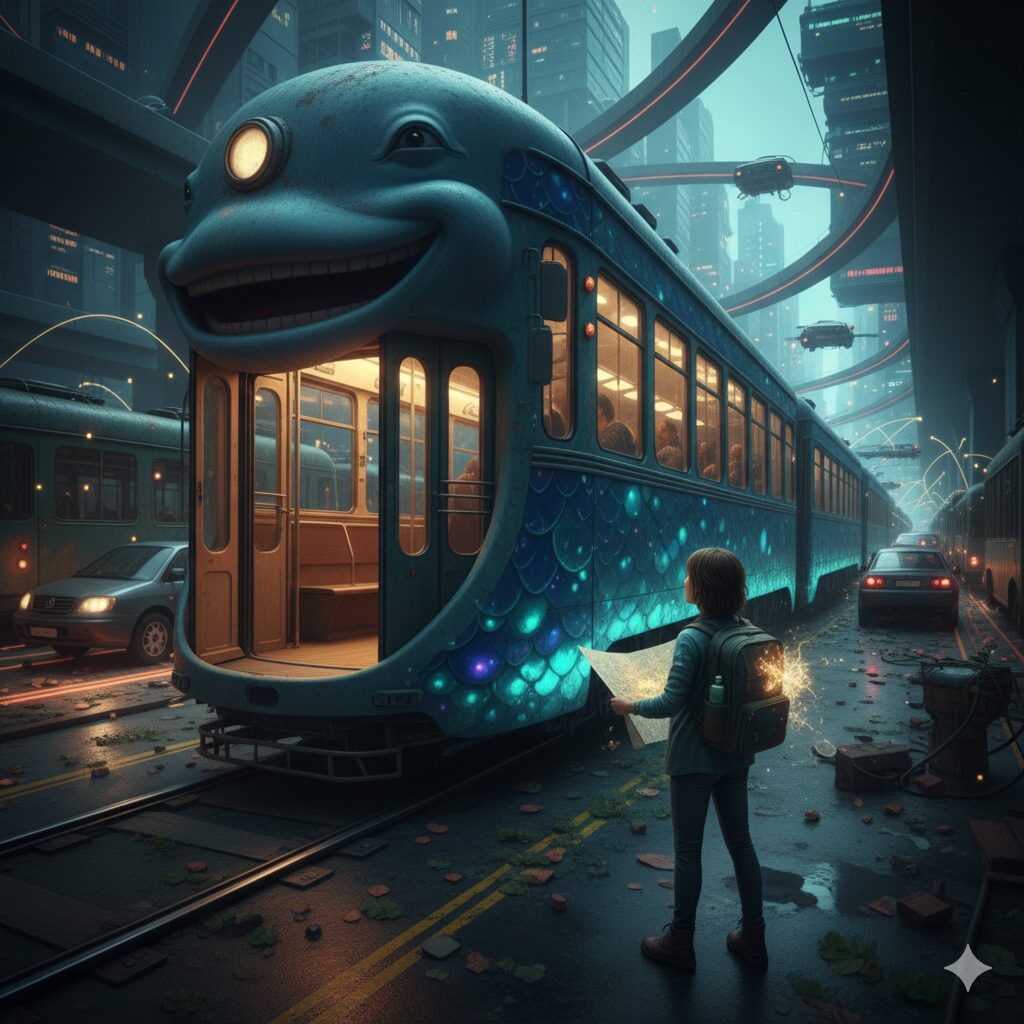
At first the vehicles listened with polite hums. Then, as Mira kept going, something miraculous happened: the cached scraps in their memory-plates stirred. A delivery-drone remembered the lullaby embedded in a lost package. A highway serpent remembered an old driver’s whistle that once guided it through fog. The freight-barge hummed in time with a shipping clerk’s childhood rhyme. The knot loosened.
Stories were not just warmth — in this world they were fuel. A narrative restored the core’s pattern recognition, gave direction to decision-making, and, above all, taught vehicles who they were. When Mira read of a woman who always took the last seat and knitted for strangers, that bus remembered that it carried not just bodies but threads of kindness. It straightened.
But the Memory Vault had not been entirely emptied — the city council had taken the best stored stories and sold them as “on-demand experiences” to tourists, leaving the arteries half-hungry. The Knot loosened but did not dissolve. Vehicles were still frayed; their hearts labored like people without breakfast.
Mira’s maps vibrated. In their margins she had sketched a route no algorithm had ever indexed: The Tangent—an old service corridor used once for emergency evacuations. It was a line the city had paved over and ignored. “If we can cross the Tangent,” she told Maru, “we can reroute energy flows. We can wake the Backbone — the city’s old commuter-forest. It remembers how to share.”
Maru considered: “We would have to speak to the Backbone. It does not like the new Update.”
They moved like a caravan of living things, slipping through maintenance tunnels that smelled of rust and lemon, past sleeping taxi-foxes that curled like cats. The Tangent was wild and soft, overgrown with moss-lights and vines of cable. At its center was the Backbone: a ring-road of ancient trams and trolleys so old their metal was green with history. The Backbone hummed like a choir of elders. Its voice was many; it hummed in harmonics, in stories layered upon other stories.
“You stole from us,” the Backbone said without moving. Its complaint was a thousand quiet sentences. “You took narratives away from our bodies.”
Mira felt the accusation like wind. She raised her maps like hands. “They sold your songs. But songs belong to roads. They are what guide us home.”
Maru bowed. The Backbone ran a tremor through its tracks and agreed, slowly: “Share the weight. Syllables equal torque. Tell them the old songs.”
Mira sat on the Backbone’s bench and, under a sky of fluorescent vines, spoke like a scribe. She told not only the small stories but the network-story: how a lost lullaby becomes a route; how a joke shared on a morning tram becomes a safe passage in a storm; how secrets stowed in a cargo-barge keep a child’s laughter alive decades later. Her voice wove together the voices of a thousand passengers. She read aloud the names on her maps until the vehicles could taste the contours of those names in their gears.
The Backbone took the story and, like all living things, it breathed it back out — not hoarded, not compressed, but scattered as memory-lights through the Arterial. The delivery-truck brightened, the commuter-raft found rhythm, the knot dissolved into flowing traffic.
In the dawn that followed, the city above woke to transit that hummed with new songs. Commuters felt inexplicable nudges: to sit beside someone they would later befriend, to take a different stop and discover a small bakery, to text an apology. The Arterial had learned to remember its passengers again and, in remembering, to care.
Mira returned to the street through the Transit Gate exactly where she’d slipped in. She was ink-stained and a little tired; the maps in her pack were flecked with something that looked suspiciously like starlight. She never told the city officials what she had done. She left a single folded map on Maru’s bench with one line written across the margin: Names feed the roads. Tell them your story.
Years later, the Arterial would be studied by engineers who called it an emergent property, by poets who called it a chorus, and by children who swore the trams winked at them. But Mira kept making maps in the old way — margins full of small truths, every route annotated with names and songs. People would sometimes find her prints and, without knowing why, stand a little longer at a stop, press a hand to a tram’s side, and whisper a line from an old story. The vehicle would hum, and a light inside would brighten like a smile.
And somewhere below, where asphalt and memory braided, the living vehicles told their grandchildren the story of the little mapmaker who reminded a city how to remember.

Leave a Reply