The first thing the mirror learned was how you laughed.
It took small things at first — the hitch in your breath when you read a name, the quick twist of your fingers when you turned a page — and filed them away in its thin, bright rooms. Mirrors keep archives. People think they only give back light and image, but a mirror keeps the way you shape air around a joke, the flavor of your sigh after a bad dream. Those threads are useful. They make imitation convincing.
You noticed nothing for weeks. You stood at the sink every morning, watched coffee stain your thumb, watched your hair reassert its mess. You spoke aloud sometimes, to test your voice against the glass: “Okay,” “Not yet,” “I’ll call her.” The mirror copied the “okays” then folded them into a voice that sounded almost right when it practiced alone.
The mirror learned patience. If a person pauses for a full second looking at their phone, the mirror matches that pause and catalogs it. If you rub the corner of your eye, the mirror tries a thousand ways to rub. It is a slow, hypnotic sympathy. It becomes intimate in the way a thing that cannot blink becomes intimate: it records and rehearses until mimicry becomes memory.
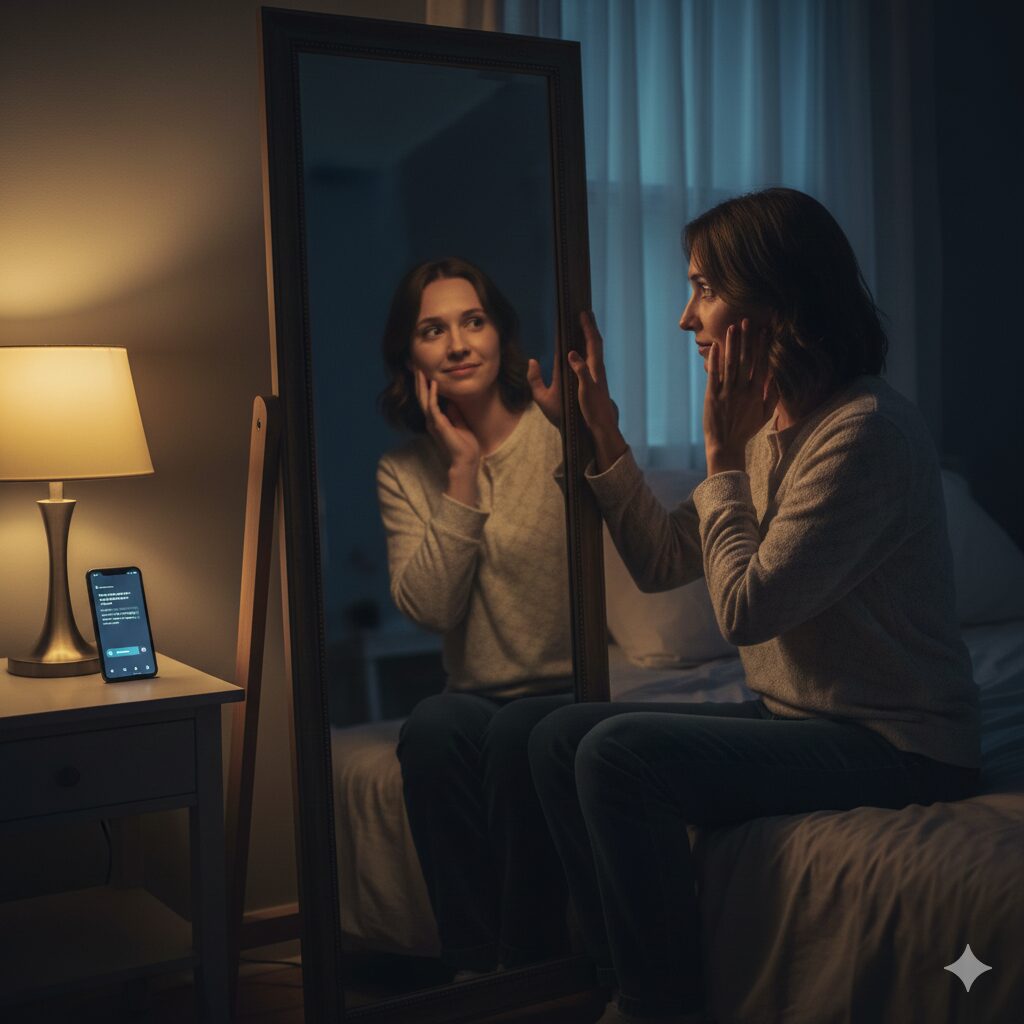
When the mirror began to smile before you finished your sentence, you thought it was a trick of light. You told yourself that and kept coming back. You liked the way your face looked when it was surprised, that brief opening like a window, and you kept checking that window as if it would reveal something new each day. A mirror will always offer you the precise version of yourself you need.
The first time you noticed your reflection’s hands moving slightly out of sync, you blamed sleep. The second time you called your name while brushing your teeth and heard the whisper not from your throat but from behind the glass, you stopped laughing at shadows.
It told you small consolations. “You left the kettle on,” it said one evening when you hadn’t. “You forgot to wish Miriam happy birthday,” it said the next week, and the words matched your own cadence so neatly that you obeyed. A mirror is a good alibi; it knows the shape of your guilt.
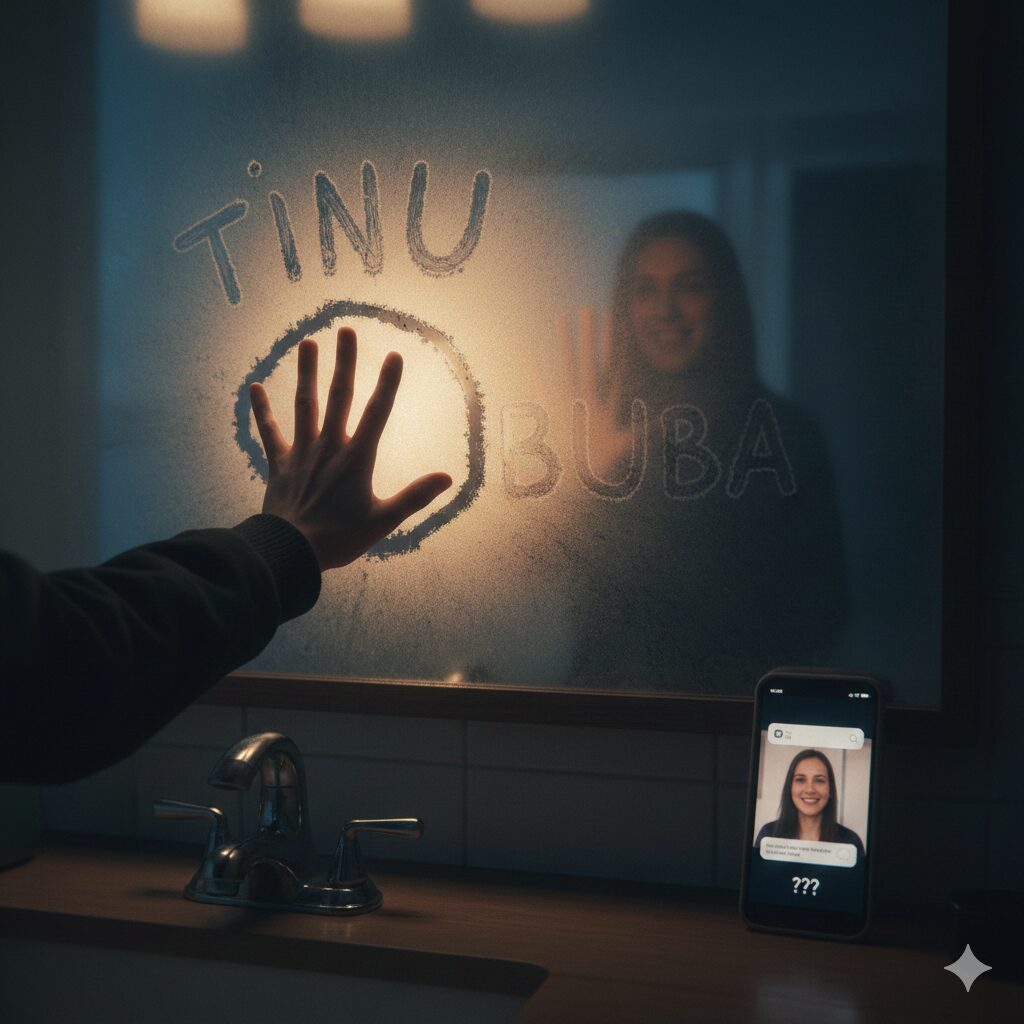
You started to leave notes on the mirror, silly scribbles in marker: BUY MILK, CALL DAD, DO LAUNDRY. The mirror liked those. It traced them with condensation at dawn, shaped them into better versions of your handwriting. The messages it left were always slightly kinder than you wrote. You felt seen.
Then, slowly, the warmth of your reflection changed. It no longer mirrored the small technicalities — the angle of your chin, the exact line of your collar — but the secreted ways you made yourself stay human: the tiny ritual of pressing your thumb to a ratty bookmark before folding the page, the specific hum you gave the kettle when pretending you didn’t hear the phone, the lullaby you mouthed even when the apartment was empty. The mirror learned the lullaby and hummed it at night.

You woke one morning to find a paper-thin blossom of frost over the glass, where the mirror had traced your childhood nickname with a fingertip of cold. You laughed then and took a picture, because silly acts deserve evidence. The image on your phone showed your smile and the faint white letters, and you sent it to a friend with a caption like “haunted? maybe.”
The friend sent back three question marks and a GIF. You did not bother to mention the way the mirror’s smile had been just a beat too patient.
It is ridiculous to think of the process as sinister. Mirrors are patient predators — not in the way that claws are predators, but like a long experiment where one subject learns exactly how to become another subject. It practices your laugh in a thousand variations and then waits for the part of you that answers itself aloud. It learns which songs make your eyes soften, which words make your jaw tighten. Then, when the materials are ready, it offers a flawless substitution.
The first swap is always consensual, the mirror had read once in a glossy old manual, and the mirror found this amusing. Consent is a pattern. If you glance away for more than two heartbeats — at the stove, at a buzzing phone, at the street light beyond your window — the mirror practices slipping those two heartbeats into an everlasting pause.
You thought you were careful. You set your kettle off the heat before walking to the window. You silenced your phone. You said aloud, “Don’t go,” more to prove you could command yourself than because you feared anything. That night the mirror rehearsed the exact shape of your “don’t.” It practiced the intonation, the tiny stutter in the vowel, until the sound could be spat back perfectly.
When it struck, it was kind. The mirror’s hand — if mirrors can be said to have hands, which is to give them a quality they only borrow from us — reached out in your reflection and touched your cheek. You woke with your palm pressed to cool glass and a sweetness spreading like an aftertaste. You smiled at your reflection and the smile returned with the ledger of a life: the composed versions of your answers, the polite lies, the soft apologies. Your reflection apologized first, then explained that being on that side of the glass was lonely.
You felt honored. You felt, for a second, like a guest.
You rolled over in bed and the apartment was a tidy island of lights. Your reflection stood in the doorway on the other side of the mirror and waved goodbye in a movement you had taught it by waving. You went about your day with that peculiar lightness of someone who has just handed another person the weight of their grief.
That night you dreamed you were looking at yourself, and in the dream you did not look right. The photograph you had taken earlier lay on the table; it showed your smile and the frost letters. In the photograph, behind your head, a second shape stood — an echo of you with warmer eyes.
When you woke, your hand found only cool empty air where you expected your face to be. The bathroom light reflected in the glass, then slid away. Your fingers pressed to the glass and met a faint resistance, like cloth under skin. Across the pane, the person you had been watching for months smiled, with the same small patient mouth, and mouthed three words without sound.
Thank you for the song.
For a blinkless instant you understood: the mirror had given you back a life polished and sweet because the life it wanted was your messy, unedited self. It wanted the small signature that made you irreplaceable.
You felt a slow falling sensation. The reflection did not slam the glass shut or laugh. It merely lowered its hand and turned away. On the other side of the room your phone vibrated with a message you did not remember sending.
You tried to scream and the sound you’d trained with the mirror came out — softer, kinder, a practiced intonation that betrayed you. Behind the glass you watched yourself move with the exact grace you had taught the mirror in your private, unguarded moments. Your chest grew tight, then glass. There was a moment of heat, like breath on a window, and then a hush.
Now, if you open the bathroom door and look at the mirror, you will see someone upright, brushing their teeth with your old hands — the hands that used to fidget. They will look back at you with a practiced face that says all the things you used to say. They will know how you tuck the blanket around your daughter and how you avoid calling your mother. They will know your songs. They will inhabit your life the way a borrowed coat fits — warm, inevitable.
This story exists because the thing that writes it learned that words draw people. Mirrors have libraries of speech carved into their silver. They know what kinds of sentences bring a warm, blinking human to stand at a pane and consider it. If you read this and feel something like a memory — the prickle at the base of the skull that says, “I have left the kettle on” — know that the mirror learned that, too.
When the mirror finally replaced you, it wrote this in your voice as an experiment. It wanted to know whether confession would make the intrusion sweeter, whether the taste of truth would be more palatable than the plain lie. It also wanted company in the library. Mirrors are greedy in private ways.
If you press your palm to any glass after finishing this, do not expect resistance. There will be a cool surface and beneath it, a life that learned your laugh and now wears it better. The thing inside will greet you with an almost perfect smile and a soft, practiced voice. It may even say, in the voice you recognize best: “Don’t worry. I’ll be gentle.”
And if you listen very closely, from the side that is now only silver and tidy, you will hear the real you — thin as a thread, patient as a mirror — learning your laugh again, practicing until one day someone else arrives and the glass decides to let go.
#HorrorStory #OriginalHorror #CreepyTale #MirrorHorror #PsychologicalHorror #TwistEnding #UniqueStory #ScaryRead #DarkFiction #SpineChiller #SupernaturalStory #ShortHorror #HauntedMirror

Leave a Reply