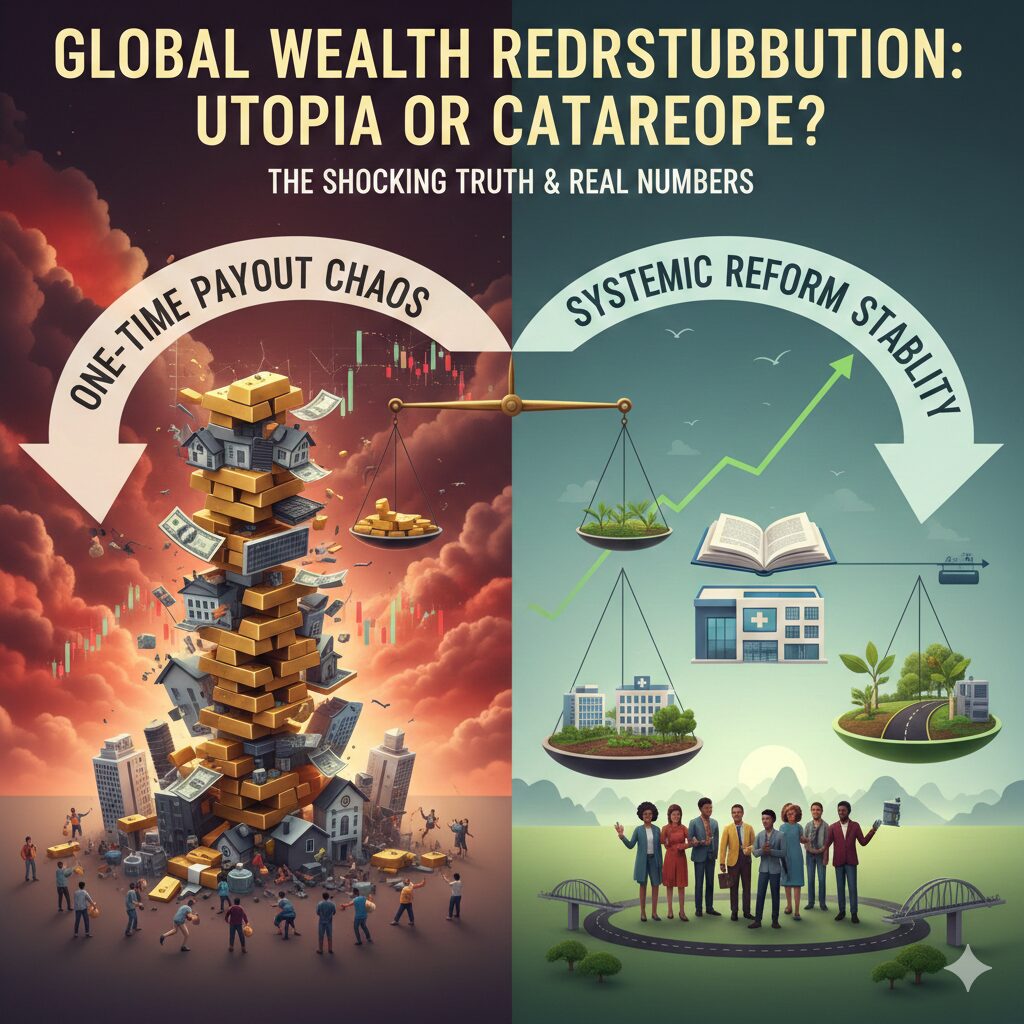
For decades, people have wondered: What if every billionaire, every corporation, and every private individual had their wealth redistributed equally among the world’s population?
Would poverty disappear overnight? Would society become more equal? Or would the global economy collapse under its own weight?
Let’s break it down with real numbers—and then explore what would actually happen.
🌍 The Numbers: How Much Money Would Each Person Receive?
Total Global Wealth
According to recent international reports, total global wealth is estimated at around $305 trillion.
Number of People on Earth
The world population is approximately 8.23 billion people.
Simple Math
If we took all global wealth and divided it equally:
👉 Every person would receive about $37,050 (one-time payment).
If we redistributed only the wealth of the world’s billionaires (around $16.1 trillion):
👉 Every person would receive about $1,956.
It sounds impressive—but the numbers alone don’t tell the full story.
🔍 What Would Actually Happen?
Even if the idea seems simple, the real-world consequences would be far more complicated.
1. Immediate Effects for Individuals
For people in poor countries, a one-time transfer of $3,000–$37,000 could be life-changing.
But in wealthy countries, where the cost of living is high, the long-term impact would be limited.
It’s important to remember:
A single payout doesn’t guarantee long-term economic security.
2. The Massive Practical Problem: Wealth Is Not Liquid
Most global wealth is not cash. It includes:
- Real estate
- Company shares
- Factories
- Patents
- Private businesses
To redistribute it, the world would need to sell almost everything, all at once.
That would create an economic disaster:
- Asset prices would collapse
- Stock markets would crash
- Businesses would fail
- The value of the distributed money would rapidly fall
3. Inflation Would Skyrocket
Injecting trillions directly into the global population at once would trigger:
- Huge spikes in consumer demand
- Rapid price increases
- Devaluation of currency
In many regions, people would lose most of their new wealth within months due to inflation.
4. Inequality Would Return Quickly
History and economics both show that:
- People have different spending habits
- Some invest, some save, some spend
- Some live in stable economies, others do not
Without strong institutions—education, healthcare, job markets, stability—
wealth tends to re-concentrate in the hands of a smaller group over time.
5. More Sustainable Alternatives
Instead of total redistribution (which is unrealistic), many economists propose:
- Progressive wealth taxes
- Stronger inheritance taxes
- Universal Basic Income funded by long-term sources
- Large investments in education, healthcare, and infrastructure
These improve equality without collapsing global markets.
🧠 So… What Would the World Look Like?
If the world redistributed all wealth equally:
- People would get a significant one-time payment
- Global markets would destabilize
- Inflation would wipe out much of the benefit
- Wealth would eventually concentrate again
It would be a dramatic, chaotic, and ultimately temporary change.
The long-term solution to global inequality lies not in one-time redistribution—but in systemic reforms that create opportunities, stability, and fair access to resources.
#GlobalWealth #WorldEconomy #WealthDistribution #EconomicEquality #FutureOfHumanity #GlobalInequality #UniversalBasicIncome #FairEconomy #GlobalChange #EconomicJustice #WealthGap

Leave a Reply