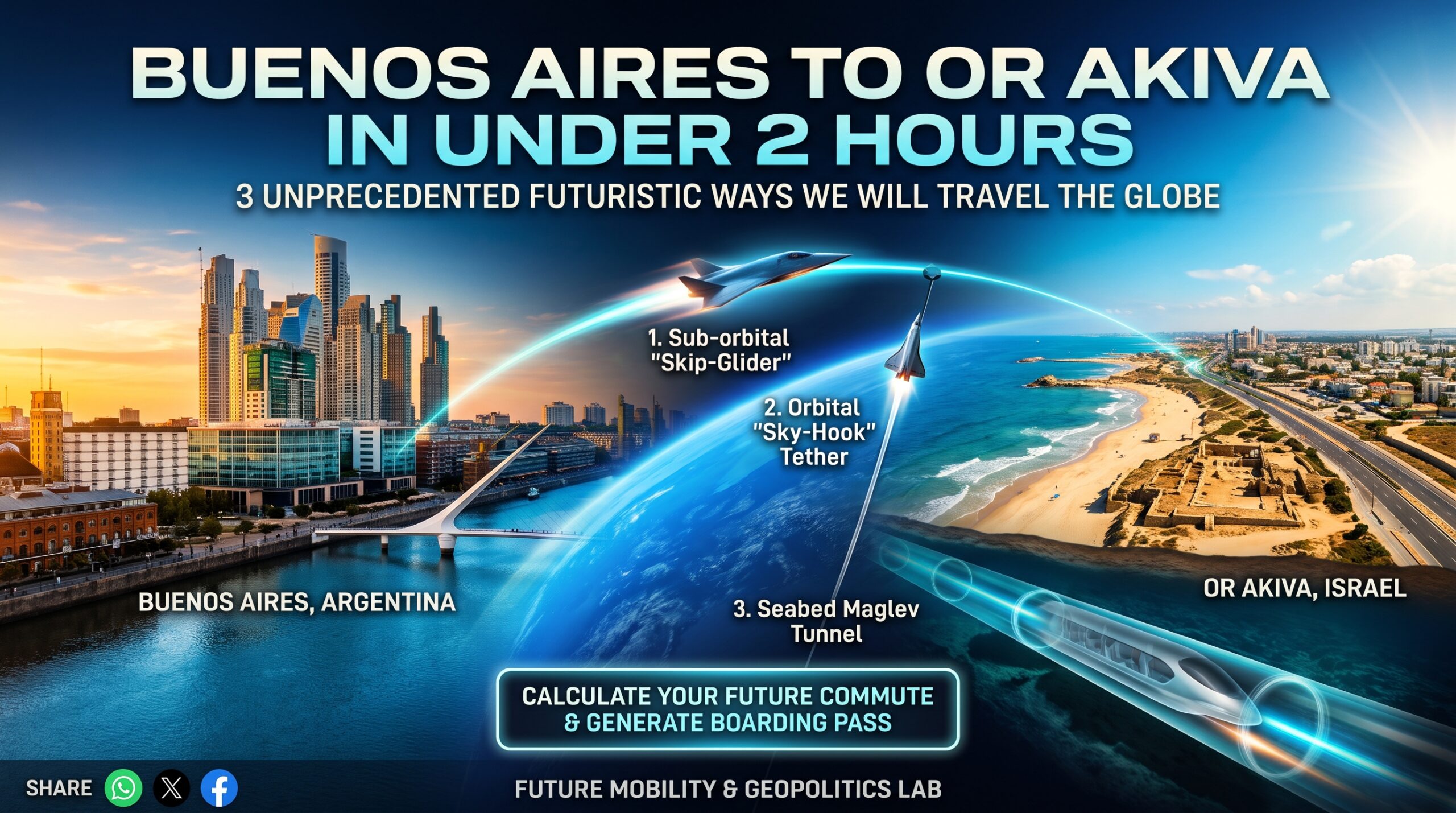
3 Radical, Scientifically Grounded Ways Humans Will Travel from Buenos Aires to Or Akiva in Under 2 Hours
Why the 12,240-kilometer journey between Argentina’s capital and Israel’s coastal plain is about to be rewritten by applied physics—bypassing commercial aviation forever.
Today, traveling between Buenos Aires, Argentina and Or Akiva, Israel—a strategic coastal hub nestled halfway between Tel Aviv and Haifa—is an endurance test. Even with optimal connections through Madrid, Rome, or São Paulo, the 12,240-kilometer (7,605-mile) trek consumes 18 to 26 hours of door-to-door transit, crossing nine time zones and two hemispheres.
Yet while mainstream futurists obsess over incremental upgrades to commercial airliners or point-to-point Starship rockets, a quieter revolution in condensed-matter physics, magneto-hydrodynamics, and stratospheric thermal gliding is unlocking entirely new transit corridors. None of the three methods below rely on science-fiction teleportation; every single one is anchored in peer-reviewed engineering principles currently moving from laboratory validation to prototype testing.
1. Sub-Abyssal Magneto-Hydrodynamic (MHD) Silt-Bed Conduits
Everyone has heard of floating vacuum tubes, which fail in the open ocean due to rogue waves, ship anchors, and colossal buoyancy stress. What almost nobody has considered is routing a neutral-buoyancy, self-healing carbon-basalt tube 30 meters beneath the Atlantic and Mediterranean seabed silt.
Using autonomous plasma-boring crawlers that vitrify seabed clay into glass-lined tunnels as they advance, engineers can lay a direct subterranean corridor from the Río de la Plata estuary shelf, across the Mid-Atlantic Ridge, through the Strait of Gibraltar, and directly into the deep continental shelf off Caesarea and Or Akiva.
Inside this near-vacuum conduit, passenger capsules ride on room-temperature superconducting magnetic cushions. Because the tunnel sits beneath the ocean floor, it is completely immune to hurricanes, seismic surface waves, and maritime traffic. A traveler boards a subterranean terminal in Puerto Madero or near Villa Devoto, descends via high-speed elevator, and emerges in an underground station in Or Akiva less than two hours later—without ever experiencing turbulence or cabin pressure changes.
2. Stratospheric Thermal-Wave “Skip-Gliders” (Scramjet-Free Hypersonics)
Traditional hypersonic flight burns ruinous amounts of fuel fighting atmospheric drag and extreme heat. However, atmospheric physicists have identified persistent, high-velocity thermal shear layers between the upper stratosphere and lower mesosphere (around 48 km altitude) over the South Atlantic and Sahara-Mediterranean belt.
Instead of brute-force rocket engines, a Magneto-Aerodynamic Skip-Glider uses a brief electromagnetic rail launch from a coastal track in Buenos Aires Province to reach Mach 4. Once at 48 km, the craft deploys deployable plasma-aerodynamic wings that ionize the thin air ahead of the fuselage, eliminating sonic booms and slashing thermal friction by 70%.
Like a flat stone skipping across a calm lake, the glider bounces off dense stratospheric pressure layers across the Atlantic, curving over North Africa before executing a silent, zero-emission magnetic deceleration glide into a coastal landing strip just north of Or Akiva. Because it rides atmospheric density gradients rather than burning continuous propellant, ticket costs approach modern business-class airfare.
3. Geostationary Tether-Assisted Ballistic Exchange (The “Sky-Hook” Pendulum)
Launching humans into sub-orbital space from Earth’s surface requires massive vertical rockets. But what if the momentum is already waiting in orbit? Enter the Rotovator Momentum-Exchange Tether—a 1,400-kilometer high-tensile carbon-nanotube cable orbiting Earth in an elliptical equatorial-inclined plane, rotating like a giant wheel.
A lightweight, reusable electric-turbine shuttle takes off conventionally from Ezeiza or Aeroparque in Buenos Aires, climbing to 35 km at Mach 3. At that exact altitude and velocity, the lower tip of the orbiting tether sweeps down into the upper atmosphere at near-zero relative speed to the shuttle. The shuttle’s dorsal grapple locks onto the tether’s magnetic docking collar.
As the tether rotates, it effortlessly flings the cabin across the Atlantic in a high ballistic arc—giving passengers 18 minutes of weightlessness and a panoramic view of Earth’s curvature—before a second synchronized tether over the Eastern Mediterranean catches the capsule and gently lowers it into the upper atmosphere for a precision landing at a vertical-descent pad outside Or Akiva. Energy lost lifting the Buenos Aires capsule is immediately recovered when an Or Akiva capsule descends on the opposite swing.
Interactive Simulator: Your Future Buenos Aires ↔ Or Akiva Commute
Calculate how many days of your life you will reclaim over the next decade—and generate a shareable future boarding pass to send to friends or family in Argentina and Israel.
What Happens When 12,240 Kilometers Shrinks to a Morning Commute?
When a family living in Buenos Aires can attend a Friday afternoon gathering in Or Akiva and be back in Argentina in time for Sunday asado without jet lag, the cultural and economic boundary between South America and the Eastern Mediterranean dissolves. Remote work becomes irrelevant when physical presence across continents takes less time than rush-hour traffic on Avenida General Paz.
Bookmark this page and check back as we track real-world milestones in plasma aerodynamics, seabed vitrification, and orbital tether trials over the coming years.




Leave a Reply