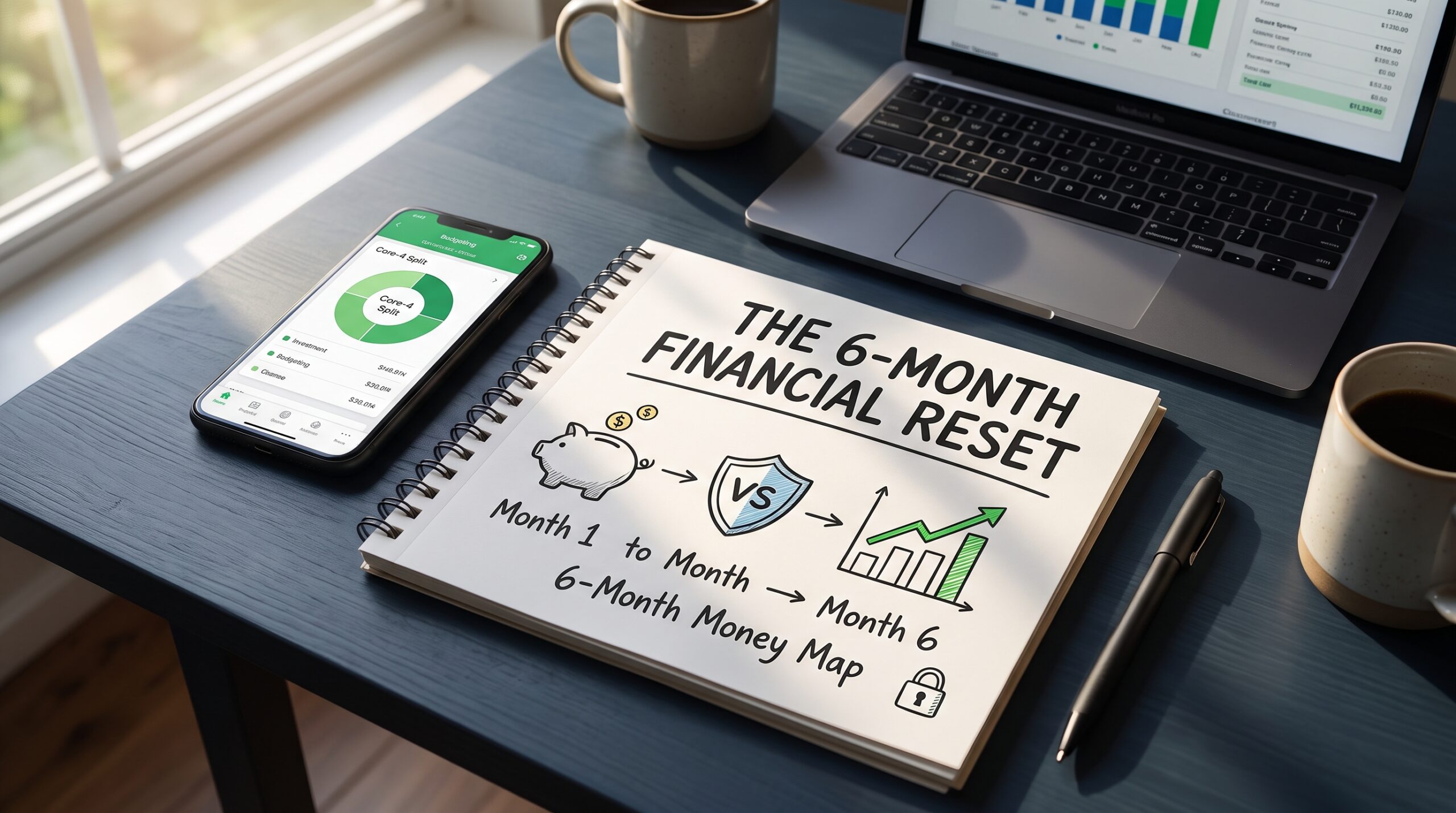
How to Change Your Finances in 6 Months: The Complete Step-by-Step Blueprint to Escape Paycheck-to-Paycheck Stress
You do not need a six-figure salary, a lucky stock pick, or extreme deprivation to fix your money. You need a sequential 180-day operating system engineered around human psychology.
Most people fail at personal finance for one predictable reason: they try to overhaul every financial habit on Day 1. They simultaneously start an aggressive budget, cut all entertainment, open a brokerage account, and promise to pay off every credit card at once. Within three weeks, willpower collapses, decision fatigue sets in, and old spending patterns return.
In his viral breakdown, personal finance creator Ivan Invests outlines why a 6-month sequential sprint is the sweet spot for lasting financial transformation. Six months is long enough to generate undeniable mathematical progress—wiping out high-interest debt, stacking an emergency cushion, and automating investments—yet short enough that you never lose sight of the finish line.
Executive Summary: The 180-Day Money Reset
- Month 1 (Clarity): Audit your Core Four Numbers for 30 days to defeat financial avoidance.
- Month 2 (Buffer): Save 1 full month of bare-bones living expenses to break the emergency-debt cycle.
- Month 3 (Defense): Eliminate all “bad debt” above 8% APR and initiate a 3–6 month emergency fund.
- Month 4 (Offense): Split surplus cash between finishing your emergency reserve and broad-market index investing.
- Month 5 (Leverage): Boost top-line income via data-backed salary negotiation or a side stream without lifestyle creep.
- Month 6 (Autopilot): Eliminate daily willpower by automating bills, savings, investments, and a guilt-free spending account.
Watch the original breakdown by Ivan Invests on YouTube. Below is our expanded step-by-step implementation guide and custom cash-flow simulator.
The Month-by-Month 6-Month Financial Reset System
The golden rule of this framework is single-threaded execution. Focus exclusively on the current month’s objective until it is locked in, then stack the next layer on top of it.
Face the Numbers & Audit Your “Core Four”
Psychologists define the Ostrich Effect as our natural tendency to avoid uncomfortable financial data—ignoring credit card statements or delaying checking a bank balance after a weekend out. Avoidance does not protect you from stress; it allows small leaks to compound silently.
For the first 30 days, do not restrict your spending or judge yourself. Simply track every dollar and categorize it into four numbers:
- Net Income: Your actual after-tax take-home pay hitting your checking account.
- Fundamental Expenses: Survival essentials only (rent/mortgage, utilities, basic groceries, essential transportation, insurance).
- Future-You Money: Any existing debt overpayments, savings transfers, or retirement contributions.
- Fun Spending: Dining out, subscriptions, travel, hobbies, and impulse purchases.
Save a 1-Month Fundamental Expense Buffer
Before aggressively paying down debt or buying stocks, build a starter shield equal to one full month of your Fundamental Expenses (for example, $2,500 if your core survival bills total $2,500).
Without a 1-month buffer, any routine disruption—a $600 car repair, a dental bill, or a broken laptop—forces you straight onto a 20%+ APR credit card, erasing months of progress. Execute a temporary 30-day sprint: cancel unused subscriptions, cook every meal at home, and pause non-essential shopping. Reframe this not as deprivation, but as buying next month’s freedom.
Kill High-Interest “Bad Debt” & Launch Your Emergency Fund
Most people spin their wheels because they treat all debt equally. Separate low-interest structural debt (such as a fixed-rate mortgage or low-APR student loans) from wealth-destroying bad debt (credit cards, buy-now-pay-later balances, and personal loans carrying interest rates above 8%).
- Step A (Debt Avalanche): Rank every debt above 8% APR from highest interest rate to lowest. Pay minimums on all accounts and direct 100% of your surplus cash flow at the highest-rate balance until it hits zero.
- Step B (Emergency Reserve): Once high-interest debt is eliminated, redirect that exact monthly cash flow into a High-Yield Savings Account (HYSA) until you hold 3 months of fundamental expenses (if you have a stable salary) or 6 months (if you are self-employed or commission-based).
Start Index Investing While Finishing Your Reserve
A common mistake is putting investing on hold for years while trying to hoard cash. Once you hit your initial 3-month safety threshold (or immediately after clearing high-interest debt), split your monthly surplus—for example, 70% toward finishing your 6-month emergency fund and 30% into investments, shifting to 50/50 and eventually 100% investing.
- Capture Employer Matches First: Contribute enough to your workplace retirement plan (e.g., 401(k)) to get the full employer match—an instant 100% return.
- Use Tax-Advantaged Accounts: Maximize tax-sheltered vehicles such as a Roth IRA (US) or Stocks & Shares ISA (UK).
- Buy Broad-Market Index Funds/ETFs: Skip speculative stock picking. Low-cost index funds tracking the S&P 500 or total global stock market spread risk across hundreds of profitable companies and have historically delivered ~10% annualized returns over multi-decade horizons.
Expand Your Earning Power Without Lifestyle Creep
You can only cut expenses down to zero, but your earning potential has no mathematical ceiling. Every job should provide either high learning or high earning—ideally both. If you have stayed in the same role for 2 to 3 years without a meaningful raise, inflation is quietly reducing your real purchasing power.
Bring market compensation benchmarks and documented ROI metrics to negotiate a raise, interview externally (job switchers consistently capture larger compensation jumps), or launch a lean digital/service side income. Even an extra $300 to $400 per month invested instead of spent on lifestyle upgrades adds roughly $50,000+ to your net worth over a decade.
Automate Your Entire Money System
By 6:00 PM on a workday, your brain has made thousands of micro-decisions. Relying on manual transfers to save or invest guarantees inconsistency. True financial freedom comes from removing willpower from the equation:
- Automate Fixed Bills: Set rent, utilities, insurance, and minimum debt payments to auto-debit right after payday.
- Pay Yourself First Automatically: Schedule automatic transfers into your HYSA and index fund brokerage on the exact morning your paycheck clears.
- Isolate Guilt-Free Fun Money: Route your remaining “Fun Spending” allowance into a separate debit card or checking account. When that balance reaches zero, spending stops automatically—zero spreadsheets required.
Interactive Tool: The 6-Month Financial Reset & Core-4 Simulator
Enter your real monthly numbers below to generate your custom Core-4 cash-flow split, 1-month buffer target, emergency fund goal, and 10-year wealth projection if you capture a raise or side income.
Manual Willpower vs. The Automated 6-Month System
| Financial Dimension | Traditional “Willpower” Approach | The 6-Month Automated System |
|---|---|---|
| Goal Sequencing | Tries to budget, pay debt, and invest simultaneously on Day 1. | One dedicated milestone per month that builds on the prior step. |
| Emergency Shock | Car repairs or medical bills go straight onto 20%+ APR credit cards. | Month 2 1-month buffer absorbs shocks without touching debt. |
| Debt Payoff Priority | Pays extra randomly across all loans regardless of APR. | Targets debt >8% APR aggressively first; leaves low-APR debt on schedule. |
| Daily Spending Control | Relies on end-of-day willpower and tedious receipt tracking. | Auto-transfers savings first; isolates fun money in a separate account. |
Frequently Asked Questions (FAQ)
1. What if saving a full 1-month expense buffer in Month 2 feels impossible on my current salary?
If your core living expenses consume 85% or more of your take-home pay, stretch Month 2 across 60 to 90 days instead of quitting. The critical rule is honesty: do not extend the timeline just to keep dining out or paying for unused subscriptions. Every $500 added to that starter buffer immediately reduces your financial fragility.
2. Why does the system set 8% interest as the cutoff between “good debt” and “bad debt”?
Over long periods, diversified stock market index funds have historically returned roughly 8% to 10.5% annually before inflation. Paying off a 22% credit card gives you a guaranteed, tax-free 22% return—better than any hedge fund. Conversely, rushing to pay off a 3.5% mortgage while forfeiting employer 401(k) matches and index compounding costs you substantial long-term wealth.
3. How often should I review my automated financial system after Month 6?
Conduct a 20-minute quarterly audit every 90 days. Check whether your automatic savings rate can increase by 1% to 2%, verify that recurring bills have not crept upward, and rebalance your investment contributions if your income has grown.



Leave a Reply