The 90-Day Password Rotation Lie
Let’s be honest: almost every traditional enterprise Active Directory environment still clings to the gospel of the 90-day password expiration rule. It feels secure. It sounds compliant. Yet, every single sysadmin knows what actually happens when users are forced to change complex passwords every three months.
They append an exclamation mark (!), increment a number (Summer2025! to Summer2026!), write it on a sticky note under their keyboard, or use predictable patterns. Instead of protecting the organization, rigid legacy password policies create massive Help Desk bottlenecks and train users to adopt insecure habits.
The Blast Radius of Predictable Passwords
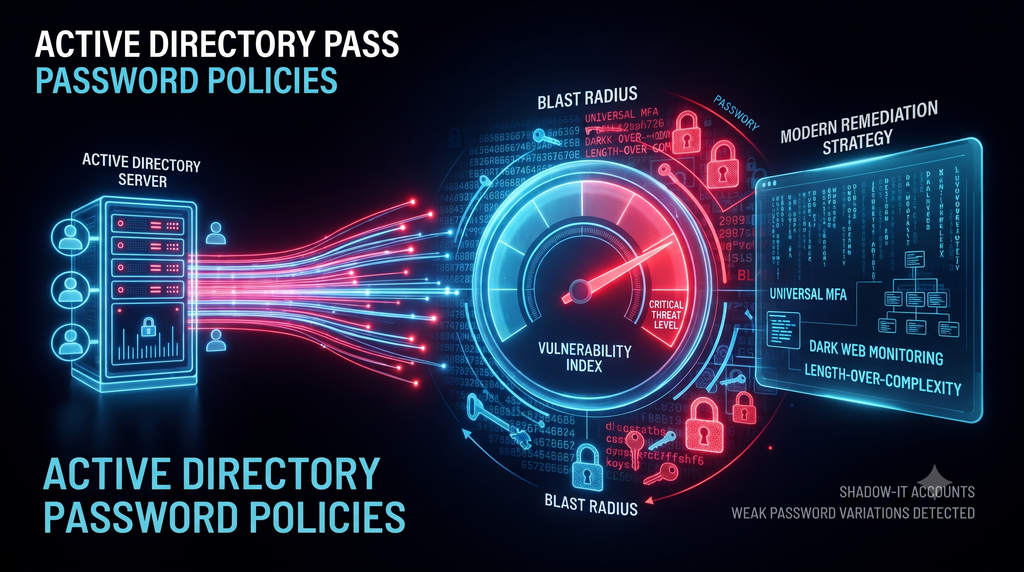
When an attacker performs credential stuffing or brute-force attacks against an enterprise, they aren’t guessing random strings—they are exploiting human predictability. If your organization lacks robust Multi-Factor Authentication (MFA) and relies solely on legacy password expiration, a single compromised workstation exposes your entire domain.
- Help Desk Fatigue: Up to 30% of all IT help desk tickets in traditional enterprises relate to password resets following mandatory expiration cycles.
- The Illusion of Security: NIST and Microsoft guidelines have formally deprecated forced periodic password resets, yet legacy mindsets persist.
- The MFA Gap: Without universal MFA and banned-password protection lists (Azure AD Password Protection / on-prem equivalent), weak passwords remain ticking time bombs.
🔍 Interactive AD Password Policy & Blast Radius Analyzer
Input your organization’s parameters below to calculate real-time vulnerability scores, monthly help desk ticket overhead, and credential stuffing risk:
Organizational Vulnerability Analysis:
Conclusion & Modern Remediation Strategy
Moving away from legacy rotation rules doesn’t mean lowering security—it means upgrading to modern identity hygiene. Combine universal MFA, continuous monitoring against leaked credential databases, and length-over-complexity rules to permanently close the blast radius.
Found this security breakdown eye-opening?
Share this article and interactive policy analyzer tool with your fellow sysadmins, IT managers, and security peers!



Leave a Reply