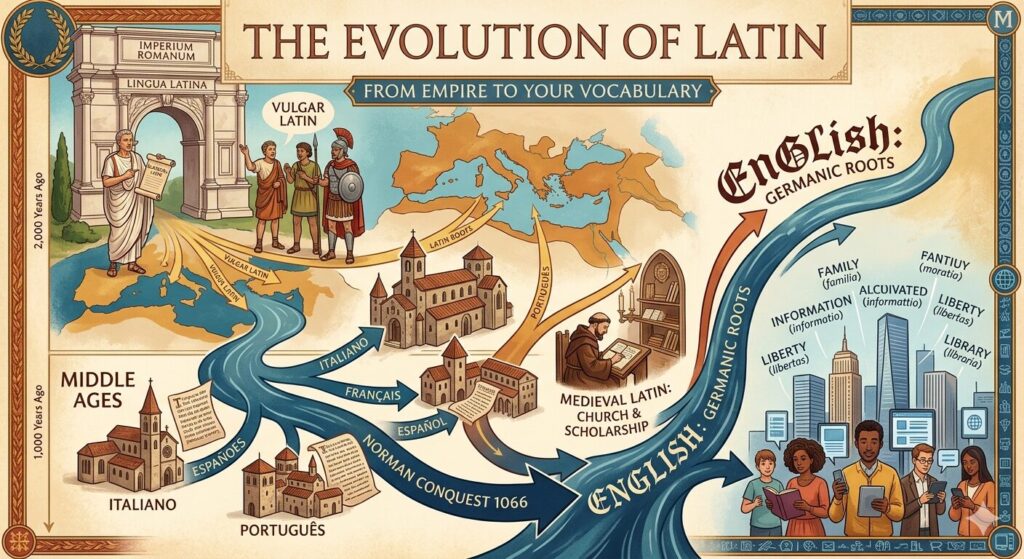
If you’ve ever wondered why a 2,000-year-old language like Latin still feels so “present” today, you’re not alone. While no one speaks Latin as their native tongue anymore, its DNA is woven into the very fabric of modern life—especially if you speak English.
2,000 Years Ago: The Living Language of Power
In 26 AD, Latin was the powerhouse of the Mediterranean. It wasn’t just a language for dusty scrolls; it was the language of the Roman legions, bustling marketplaces, and the halls of the Senate.
• Classical Latin: The refined version used by poets like Virgil and leaders like Julius Caesar.
• Vulgar Latin: The “street version” spoken by common citizens and soldiers. This version was more flexible and simpler, and it eventually gave birth to the Romance Languages (Italian, French, Spanish, Portuguese, and Romanian).
1,000 Years Ago: The Great Shift
By 1026 AD, the world looked very different. The Western Roman Empire had fallen, and the “unified” Latin had fractured into local dialects.
• In Rome, people were speaking an early ancestor of Italian.
• In the East, the Byzantine Empire (the “Eastern Romans”) mainly spoke Greek.
• Latin itself became “Medieval Latin”—a specialized language used exclusively by the Church, scientists, and lawyers across Europe.
The Big Question: Is English Actually Latin?
It’s a common mistake to think English is Latin. Technically, they belong to different families:
• English is a Germanic language (related to German and Dutch).
• Latin is an Italic language.
However, English is often called “the most Latin of the Germanic languages.” After the Norman Conquest in 1066, French (a Latin-based language) became the language of the English ruling class. Over centuries, English “stole” thousands of words from French and Latin.
[Image showing a family tree of Indo-European languages highlighting the Germanic and Italic branches]
Why Should We Care Today?
Latin might be “dead,” but it is effectively a linguistic superpower.
• Science & Medicine: When a doctor talks about your tibia or a scientist names a Tyrannosaurus Rex, they are using Latin.
• Law: Concepts like Alibi (elsewhere) or Pro bono (for the good) are straight from Ancient Rome.
• English Vocabulary: Over 60% of English words have Latin or Greek roots. If you know a little Latin, you can often guess the meaning of words you’ve never seen before.
Latin (2,000 years ago)
• Language Family: Italic
• Status at the time: Living and dominant throughout the Mediterranean.
• Alphabet: Used the Latin alphabet (the same core system we use today).
• Legacy: It eventually evolved into the modern Romance languages, such as Italian, French, and Spanish.
Modern English
• Language Family: Germanic
• Status today: Living and a primary global language.
• Alphabet: Uses the Latin alphabet (with a few modifications and extra letters like J, U, and W).
• Legacy: While its roots are Germanic, it has absorbed over 60% of its vocabulary from Latin and French.
Conclusion:
Latin didn’t die; it simply transformed. It moved from the streets of Rome into the dictionary of every English speaker. Next time you use the word “family,” “information,” or “library,” remember—you’re speaking a bit of Roman history.

Leave a Reply