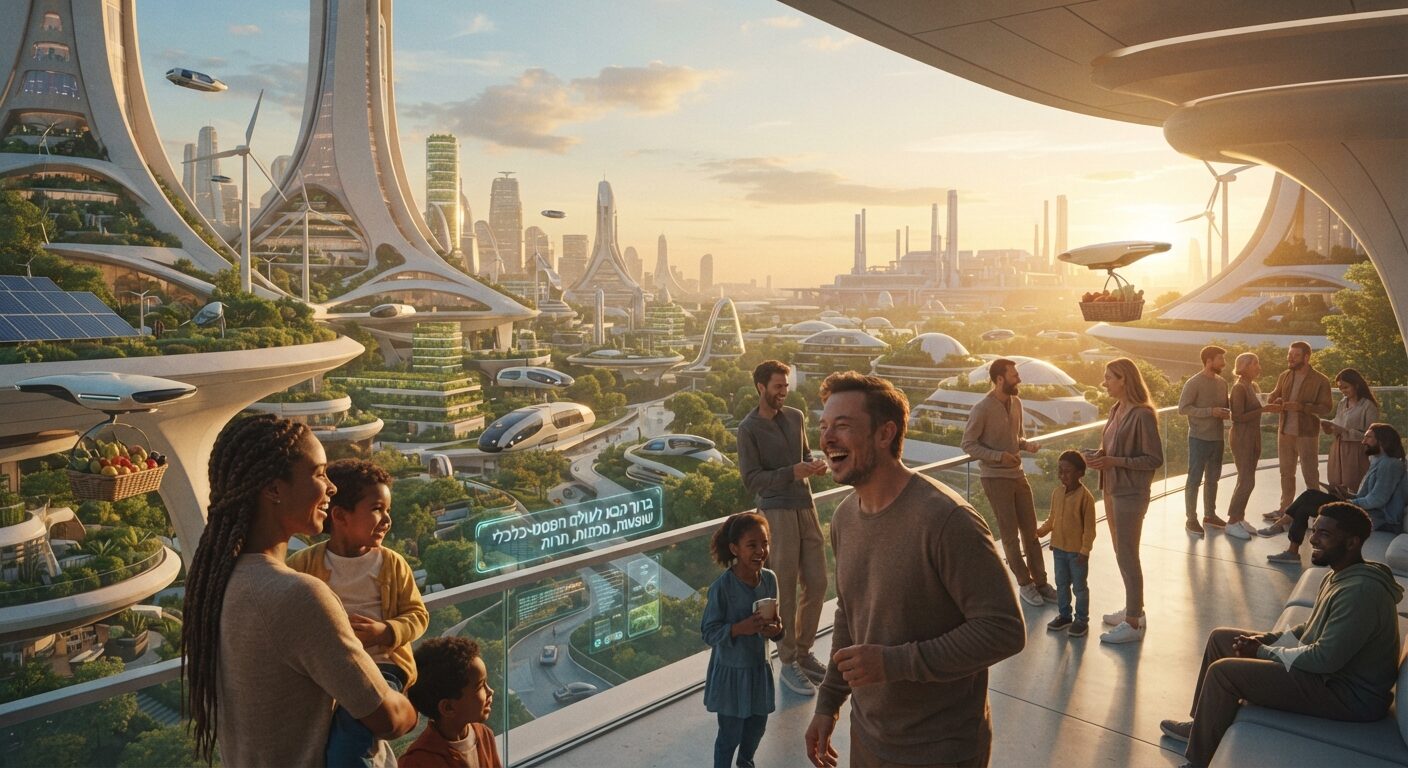
In recent years, Elon Musk has frequently shared futuristic statements that challenge everything we know about economics, work, and money. In one of his prominent remarks, Musk argued that in the near future, money will lose all real meaning, and work will become an optional choice rather than a survival necessity. At first glance, these statements sound like wild science fiction, but they are rooted in economic and technological theories known as a Post-Scarcity Economy.
1. The Abundance Revolution: When Production Costs Plummet to Zero
The basic premise of modern economics revolves around “scarcity”—resources in the world are limited, and therefore an exchange medium (money) is needed to allocate them efficiently. However, Musk argues that as advanced artificial intelligence (AI) systems integrate with humanoid robotics (such as Tesla’s Optimus robot), human labor in manufacturing, agriculture, construction, and logistics will be replaced by automated systems operating around the clock at a near-zero marginal cost.
The Outcome: The production of massive, unimaginable quantities of goods, food, energy, and services. When the supply of goods becomes virtually infinite, product prices plummet to a level that allows every individual to obtain all their needs for free or at almost zero cost.
2. From Workers to “Universal High Income”
A central question that immediately arises is: what happens to humans who lose their jobs to machines? According to Musk, the social model will need to undergo a radical transformation. Instead of unemployment accompanied by poverty, the immense wealth generated by robots will flow back to the public through advanced economic models, such as Universal High Income.
In such a scenario, humans will not need to work to survive, and work will transform into an activity of personal choice—pursued purely for fulfillment, creativity, or self-actualization.
3. Sci-Fi Inspiration: A World Without Money
Musk does not hide the inspiration behind this vision. He has previously noted that he is deeply influenced by the famous “The Culture” science fiction book series by Iain M. Banks. The series depicts a galactic society where machines manage all infrastructure, production, and food, and humans live in complete freedom without even knowing the concept of money.
Criticism and Challenges Ahead
Despite the charm and optimism characterizing this vision, many economists express deep skepticism. The central question left open is the issue of ownership and distribution: who exactly will control the robotic systems and algorithms? If ownership of technology concentrates in few hands, social gaps could widen drastically, making the world centralized and dangerous rather than egalitarian.
For the “world without money” vision to materialize positively, humanity will need to develop not only the technology itself, but also innovative legal and moral frameworks to ensure that this vast abundance is truly shared among all of mankind.



Leave a Reply