The Invisible Architecture of Caves
Beneath the bustling surface of our world lies a quiet, hidden realm where time moves at an entirely different pace. Far from sunlight and wind, deep inside limestone caverns, nature engages in a slow, meticulous choreography. Here, stone becomes fluid, and water acts as the ultimate master sculptor.
Every magnificent formation we encounter in a cave—whether hanging delicately from the ceiling or rising steadily from the floor—tells a story of patience, chemistry, and endurance that spans tens of thousands of years.
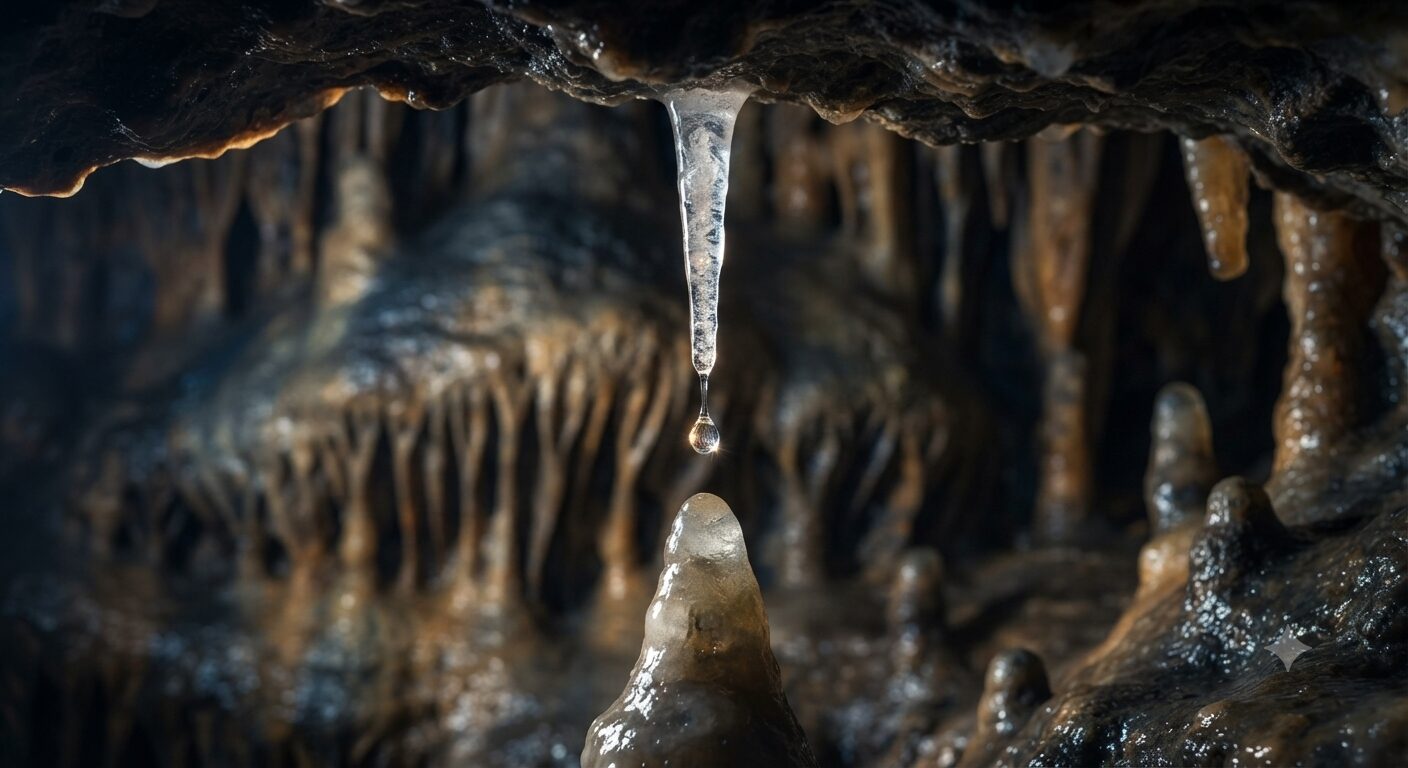
“Over thousands of years, a single mineral-rich drop of water transforms a silent cave into a masterpiece of stone, bridging the gap between ceiling and floor.”
The Chemical Alchemy of Stone
The creation of stalactites and stalagmites is not merely a physical deposit of mud or sediment; it is a delicate chemical dance. Rainwater absorbs carbon dioxide (CO2) as it filters through the soil, becoming a weak acid capable of dissolving limestone (CaCO3).
As this calcium-laden droplet hangs from the cave ceiling, it releases a microscopic amount of carbon dioxide into the air. This release triggers a chemical reaction:
Unable to hold the dissolved minerals any longer, the droplet leaves behind an infinitesimal ring of calcite before falling. Multiply this tiny mineral ring by billions of drops over countless millennia, and hollow stone straws grow into majestic stalactites.
Meeting in the Middle: Stalactites vs. Stalagmites
While stalactites cling tightly to the ceilings, pointing downward like frozen icicles of stone, their counterparts—stalagmites—rise upward from the floor. Each drop that falls from a stalactite hits the cave floor below, splashing mineral deposits upward to build a corresponding column from the ground up.
In rare and magical instances, these two vertical architectures grow toward each other over vast epochs until they finally meet, fusing into a solid stone pillar that helps support the immense weight of the earth above.
Why We Are Fascinated by Earth’s Quietest Sculptures
In our fast-paced modern lives, everything is instant. We live in an era of rapid communication, automated workflows, and immediate gratification. Yet, when we witness a time-lapse or an up-close glimpse of cave formations growing drop by drop, we are drawn into a profound sense of awe.
These subterranean wonders remind us of scales of time far beyond our own daily horizons. They teach us that some of the most enduring, breathtaking beauty in the universe cannot be rushed—it requires steady, silent persistence.



Leave a Reply