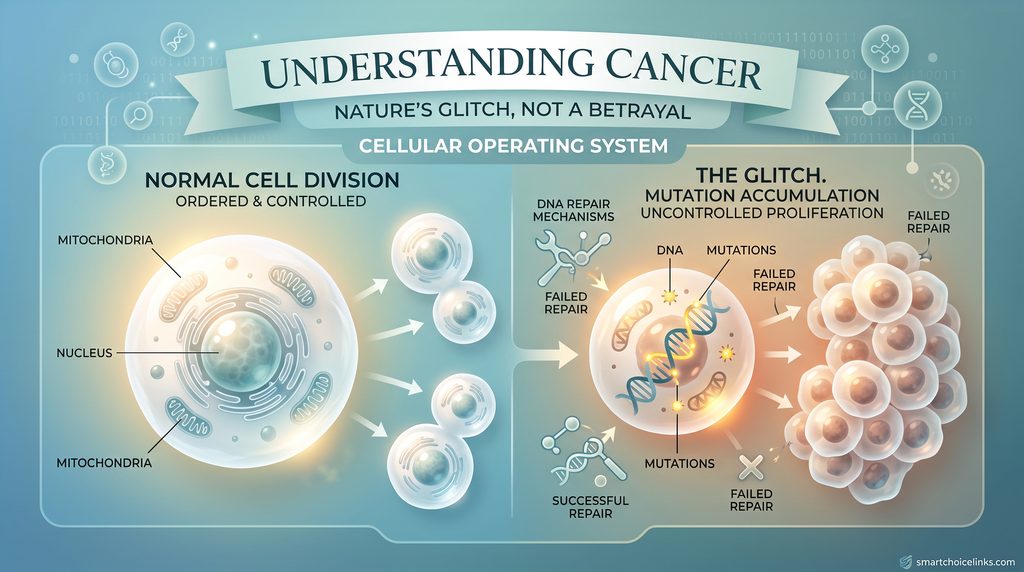
Understanding Cancer: Nature’s Glitch, Not a Self-Betrayal
A reassuring look into cellular mechanics, evolutionary trade-offs, and why cancer happens.
When we hear the word “cancer,” it is easy to feel as though our own body has somehow turned against us. We often ask: Why would the body attack itself? What is the logic behind it?
To find comfort and clarity, we must understand one fundamental truth: cancer is not an intentional self-attack. It is not a designed mechanism, nor is it a sign of internal betrayal. Instead, cancer is a statistical “glitch” in the intricate operating system that keeps us alive.
How the Glitch Happens
Every single day, billions of cells inside your body divide to replace old, worn-out, or damaged tissues. Each time a cell divides, it must precisely copy its entire DNA sequence—amounting to roughly 3 billion molecular letters.
- Copying Errors (Mutations): With such vast amounts of data, occasional typos occur. The vast majority of these errors are instantly caught and repaired by internal cellular monitors or result in controlled cell self-destruction (apoptosis).
- Accumulation of Errors: Over time, a single cell might accumulate several key mutations specifically within its “emergency brake” genes—the controls that dictate when to stop dividing.
- Uncontrolled Proliferation: Having lost its internal guidance system, this single cell ignores signals from surrounding tissues, continues dividing rapidly, and eventually forms a cluster known as a tumor.
The Evolutionary Trade-Offs
Why hasn’t millions of years of evolution completely eliminated cancer? The answer lies in necessary biological balance. The very features that allow complex life to thrive also carry an inherent risk:
| Essential Function | Why We Need It | The Associated Risk |
|---|---|---|
| Tissue Regeneration | Allows wounds to heal and replaces constantly decaying gut, skin, and blood cells. | More cell divisions mean a higher statistical chance of random DNA copying errors. |
| Immune Self-Tolerance | Prevents the immune system from attacking healthy organs and causing autoimmune diseases. | Because cancer cells are our own body cells, they can sometimes hide undetected. |
| Longevity & Complexity | Enables humans to live long lives and raise complex generations. | DNA damage accumulates over decades, making cancer primarily a condition of later age. |
A Reassuring Perspective
Cancer is simply the flip side of a remarkable coin: our ability to grow, heal, and regenerate. Recognizing that cancer stems from a mechanical error rather than a body’s failure to care for itself shifts our perspective from fear to understanding.
With modern advances in targeted therapies, immunotherapy, and early detection, medical science is learning to re-teach our immune system how to recognize these glitched cells and restore natural order.
Empower Others with Knowledge
Help demystify health science and replace anxiety with understanding. Share this insightful article with your network today!



Leave a Reply