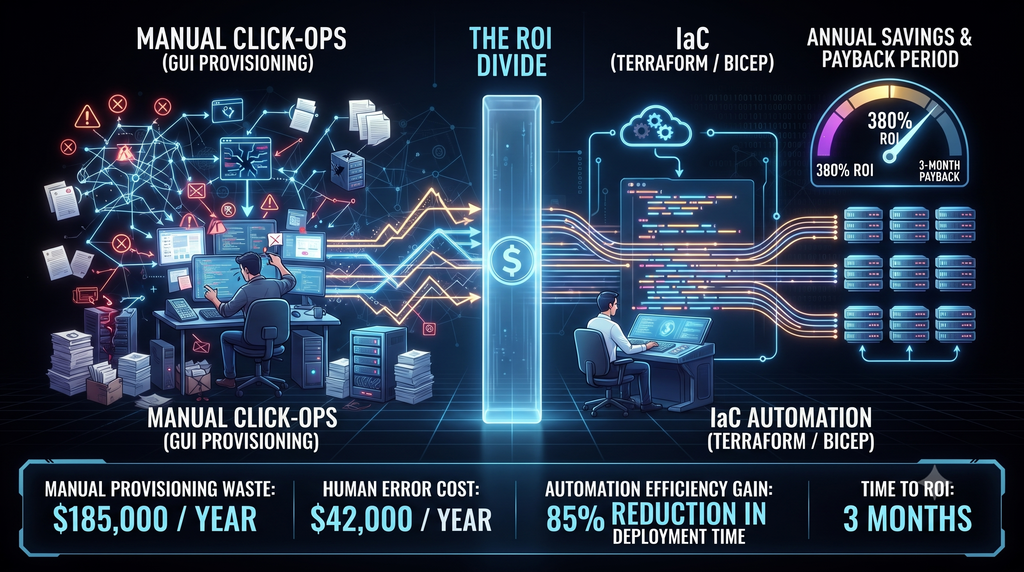
The GUI Click-Ops Trap: How to Prove the ROI of Terraform & Bicep to a Skeptical CFO
Every infrastructure engineering manager knows the feeling. You log into the Azure Portal or AWS Console, click through twenty nested menus, configure subnets, assign security groups, and deploy a virtual machine. It feels productive. But multiply that across dozens of clusters, environments, and routine hotfixes, and your top-tier engineers are reduced to expensive, glorified data-entry clerks.
When you approach executive management and ask for a dedicated project window to migrate your architecture to **Infrastructure as Code (IaC)** using **Terraform** or **Azure Bicep**, the CFO looks at you and asks a brutal question: “We already have a working GUI. Why should we invest engineering hours and budget to rebuild what’s already running?”
The Hidden P&L Killer: Click-Ops vs. Code
Traditional manual provisioning (often mocked in DevOps circles as “Click-Ops”) carries hidden operational costs that never show up neatly on a standard cloud billing invoice:
- Human Error Drift: Manual configuration inevitably leads to snowflake servers—environments that differ slightly from one another, causing mysterious staging-vs-production bugs.
- Onboarding Friction: Teaching a new sysadmin how to click through GUI wizards takes weeks. Handing them a clean, modular Terraform repository takes hours.
- Disaster Recovery Latency: Rebuilding an entire cluster from scratch following an outage via manual UI steps takes days of panic. Rebuilding via `terraform apply` takes minutes.
📊 Interactive Terraform / Bicep ROI & Migration Estimator
Input your organization’s operational metrics below to calculate wasted engineering hours, human error costs, and exact payback timelines for adopting IaC:
Financial & Operational Impact Analysis:
Conclusion & Next Steps
Moving from manual infrastructure management to declarative Infrastructure as Code isn’t just about modernizing toolsets—it’s about protecting your bottom line from human error and freeing your top talent to focus on high-value innovation.
Found this ROI breakdown and calculator useful?
Share this article and interactive tool with your fellow infrastructure managers, DevOps peers, and engineering leaders!



Leave a Reply