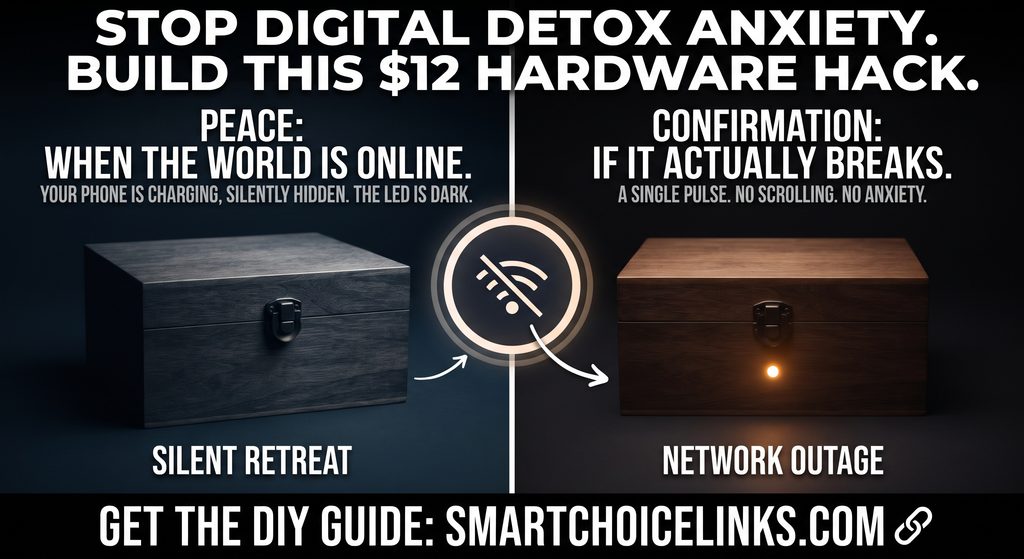
The Zero-Screen Pulse Box: How to Build a Silent Retreat Phone Lockbox with a One-Way Outage LED
Searches for “silent retreat” and “digital detox” are exploding—yet the moment a rumor of a global internet outage or service crash hits, your brain panics and unlocks your phone. Here is the $12 DIY hardware hack that gives you physical peace of mind without ever showing a screen.
The Hidden Trap Behind Every “Silent Retreat”
Look at global search trends right now and you will see two opposing forces colliding: millions of people searching for silent retreats, dopamine detoxes, and offline weekends—while simultaneously spiking searches for “is the internet down,” “cloud outage,” and “global network crash.”
That collision creates a psychological trap. You put your phone in another room to disconnect. Ten minutes later, your brain whispers: “What if something critical broke? What if banking, DNS, or emergency infrastructure went down?”
You tell yourself you will unlock your screen for three seconds just to check status. Forty-five minutes later, you are knee-deep in doomscrolling feeds, outrage headlines, and unread notifications. Existing timed lockboxes fail because they force blind anxiety—they lock you out without giving you a calm, non-digital signal that the outside world is still intact.
You do not need a screen to know whether global infrastructure is healthy. You only need a single bit of physical information: All Clear vs. Confirmed Disruption. Once your brain can see a physical object verifying stability, the urge to open a feed vanishes completely.
The Solution: The DIY “Zero-Screen Pulse Box”
The Zero-Screen Pulse Box is a compact, foam-lined wooden or metal enclosure that physically hides and charges your smartphone while exposing only one single-color LED on the outside wall.
- Inside the box: A short charging cable feeds through a small side grommet so your phone charges quietly with its screen completely concealed behind a latched lid.
- On the outside: A single 5mm LED wired to a tiny ESP32 or Raspberry Pi Zero runs a silent background
pingto a public DNS resolver or critical status endpoint once every 15 minutes. - The Genius Trick: When the internet and core services are healthy, the LED stays completely OFF. Zero distraction. Zero glowing light in your bedroom or cabin. Only if a genuine, confirmed network or critical service outage occurs does the LED emit a single, slow, rhythmic pulse.
No numbers. No push alerts. No panic-inducing headlines. Just silent physical confirmation that the world has not collapsed—while your phone stays safely locked inside.
Zero-Screen Pulse Box Simulator & Custom Firmware Generator
Test how the silent LED behaves, calculate your screen-time recovery, and generate ready-to-flash ESP32 code tailored to your retreat.
Your phone is charging invisibly inside. Because the LED is completely off, your nervous system knows everything is online without touching a screen.
What You Need to Build It (Under $18 Total)
| Component | Specification | Why It Matters |
|---|---|---|
| Lockable Box | Small wooden or metal keepsake box + acoustic foam | Blocks screen glow and muffles vibration motors completely. |
| Microcontroller | ESP32 / ESP8266 / Raspberry Pi Zero W | Connects to Wi-Fi once every 15 minutes and sleeps in between. |
| Single LED + Resistor | 1x 5mm warm amber LED + 220Ω resistor | Warm amber does not disrupt melatonin or night vision. |
| Short Charging Cable | 15cm braided USB-C / Lightning cable | Keeps your phone at 100% battery so you never open the lid to check charge. |
Step-by-Step Assembly in 25 Minutes
- Line the Box & Drill Two Clean Ports: Glue thin craft or acoustic foam to the inside lid and bottom so your phone sits snugly without rattling. Drill one small side hole for the charging cable and one 5mm front hole for the LED bezel.
- Mount the Single Status LED: Push the 5mm warm amber LED through the front hole from the inside. Solder or jumper the longer leg (anode) through a 220Ω resistor to GPIO 2, and the shorter leg (cathode) to GND.
- Flash the 15-Minute Silent Ping Code: Copy the generated firmware from the tool above, enter your Wi-Fi credentials, and upload it to your board. Tuck the board into a corner pocket inside the box.
- Lock, Plug In, and Disappear: Plug your phone into the internal charging cable, close the latch, and walk away. As long as the front of the box stays dark, everything is fine.
Frequently Asked Questions
A constantly glowing light still acts as a visual cue that pulls attention toward your device. By making “healthy” completely dark and invisible, the box blends into your room like a piece of furniture until an actual anomaly occurs.
The generated firmware includes a double-verification retry loop: if the first ping fails, it waits 15 seconds and tests a secondary backup DNS before triggering the slow pulse—eliminating false alarms from brief router hiccups.
Yes. Power the ESP32 from a small USB power bank inside the box and connect it to a mobile hotspot or local router—no wall outlet needed for a full 72-hour offline reset.
Related posts:
 How to Change Your Finances in 6 Months: The Complete Step-by-Step Blueprint to Escape Paycheck-to-Paycheck Stress
 How to Build a Personal Brand in 2027: The 3-Stage Strategy That AI Cannot Replace
 Welche Supermärkte haben heute geöffnet? Live-Übersicht & Öffnungszeiten an Sonn- und Feiertagen
 Marvel Strike Force Character Guides & Shard Calculators


Leave a Reply