How to Evaluate a Marvel Strike Force Character
A useful Marvel Strike Force character guide should do more than list abilities or repeat a tier ranking. It should help players understand what a character does, where that character can contribute, which teammates matter, how to plan progression, and whether the required investment makes sense for their own roster. This character intelligence framework brings those questions together in one practical guide.
Our approach: evaluate each character in context. A character’s value can change with game mode, team availability, roster development, current events, balance updates, and the resources a player can realistically spend.
1. Marvel Strike Force Character Role, Kit and Core Mechanics
Start by understanding the character’s official role, traits, team tags, and ability effects. A character’s kit should be read as a complete system: Basic, Special, Ultimate, and Passive abilities can interact with one another and with specific allies. Pay attention to conditions such as turn order, required teammates, game-mode restrictions, target selection, positive and negative effects, and ability cooldowns.
When researching this character abilities explained, distinguish between what an ability explicitly does and what you infer about its strategic impact. The guide should identify conditions and limitations rather than describing every ability as universally powerful. Always verify ability text against current in-game information or an official developer source before making a specific claim.
2. Best Game Modes: Where Is This Character Most Useful?
There is no single ranking that accurately describes every roster and every game mode. Evaluate the character separately for the modes in which the character’s traits and mechanics are relevant. Depending on the character, this may include Alliance War, Arena, Cosmic Crucible, Raids, Dark Dimension, Trials, Campaigns, or limited-time events. Do not assume that strong performance in one mode means the same character is essential everywhere.
Mode-specific value
Explain the match conditions, team rules, and mechanics that make the character useful in a particular mode. Mark a mode as unverified when reliable current evidence is unavailable.
Roster-dependent value
Explain whether the character needs a complete team, specific allies, high investment, or a particular roster stage to perform as intended.
3. Best Team Synergy and Character Combinations
Team recommendations should explain why characters work together, not just provide a list of five names. Look for shared traits, ability callouts, assists, passives, buffs, debuffs, speed or turn interactions, and mode-specific bonuses. Separate the intended team from alternative combinations, and state when an alternative is a theorycraft option rather than a proven counter or established team.
Players searching for the best team for this character in Marvel Strike Force also need to know what happens when a key teammate is missing. A helpful guide identifies essential allies, flexible slots, substitute options, and the trade-offs that come with each substitution. Do not label a lineup as the current best team unless the recommendation has been checked against the current game environment.
4. Character Investment Guide: Gear, Stars, Abilities and ISO-8
Upgrading a character competes with every other demand on a player’s roster. A responsible Marvel Strike Force character investment guide should separate unlock requirements from long-term build recommendations and explain the opportunity cost of each upgrade.
| Investment area | What players should evaluate | Evidence to verify |
|---|---|---|
| Character shards and stars | Unlock and promotion milestones, plus the practical benefit of each milestone. | Current shard requirements and in-game promotion rules. |
| Gear and level | Mode requirements, survivability, ability scaling, and roster-wide resource cost. | Current gear requirements and upgrade costs. |
| Ability materials | Which ability upgrades change a key mechanic and which are lower priority. | Exact ability text, upgrade levels, and material costs. |
| ISO-8 | Class choice, team role, mode, and the effect of the selected class. | Current class bonuses and character interactions. |
| Red Stars and Diamonds | Whether extra stats meaningfully improve the character’s assigned role. | Current promotion system and player-specific resource availability. |
Avoid universal statements such as “take every character to the maximum gear tier” or “upgrade every ability immediately.” The right investment depends on the player’s objectives, current roster, available resources, and any event or mode requirement.
5. Character Unlock Strategy and Shard Farming Progression
A useful how to unlock this character in MSF guide should list only currently verified acquisition methods. Depending on the character and the active game schedule, possible sources may include events, milestones, campaign nodes, stores, orbs, and other in-game rewards. Availability changes, so historical acquisition methods must not be presented as currently active without a fresh check.
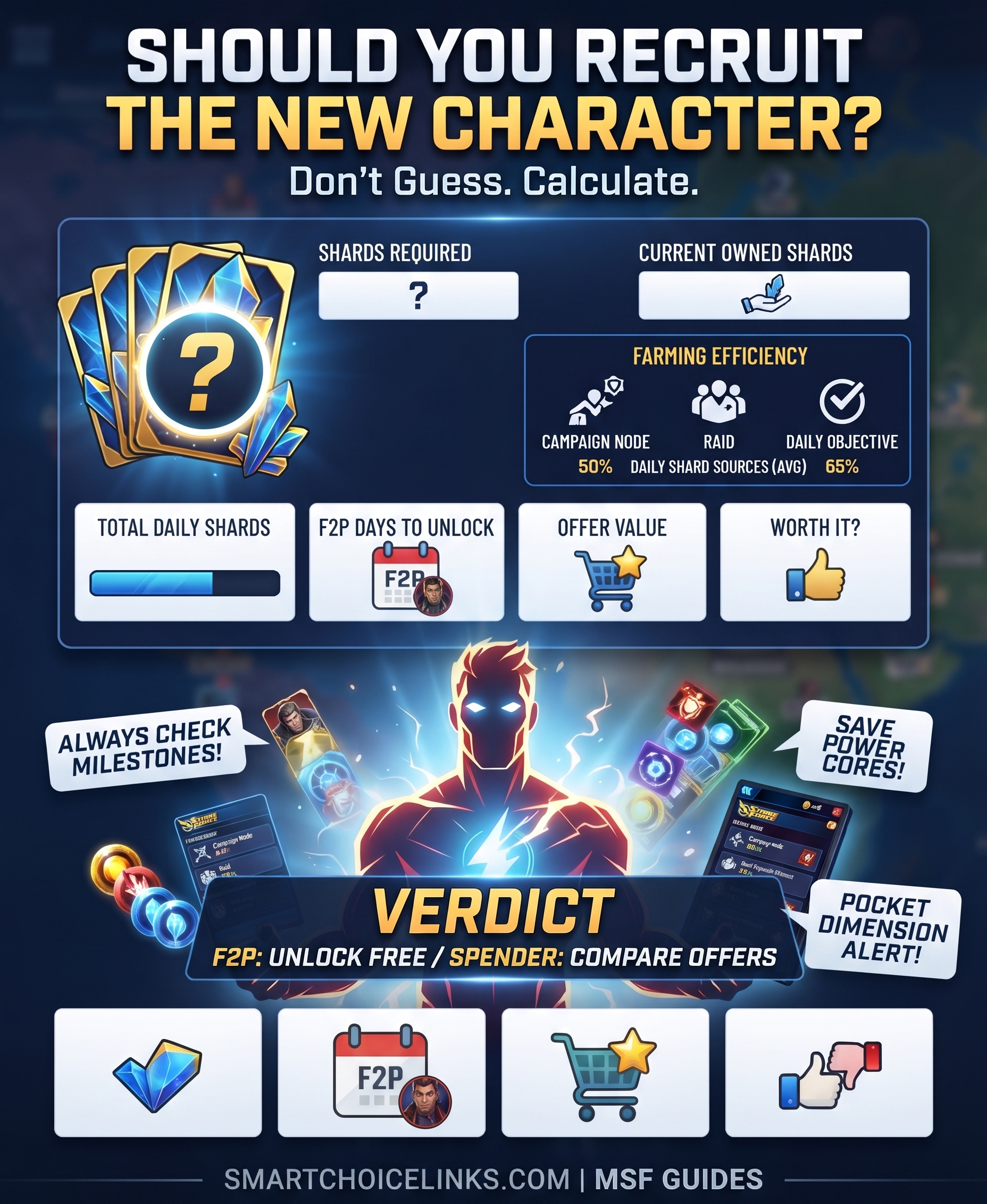
Before planning a farm, confirm the number of shards required for the next milestone, the current source of shards, any daily attempt limits, event end dates, and whether the source is guaranteed or random. A shard calculator is most useful when its inputs are transparent and its result explains exactly which assumptions were used.
Shard farming reminder: estimated completion time is not a promise. Random drops, changing event schedules, limited attempts, and newly added acquisition sources can all change the result. Display the calculation assumptions beside every estimate.
6. Free-to-Play vs. Spending: Make a Resource-Aware Decision
Free-to-Play players and players who occasionally purchase offers can use the same character guide, but their resource constraints may be different. A fair MSF character unlock strategy for free-to-play players should identify the non-paid routes that are confirmed to be available, the time or resource trade-offs, and any uncertainty around future availability.
For players considering an offer, compare the displayed price, included rewards, remaining shard gap, and the player’s own goals. Do not claim that an offer is good value without checking its actual contents and price in the player’s region. There is no need to spend simply because a character is new.
7. Strengths, Weaknesses, Counters and Limitations
A balanced Marvel Strike Force character review should cover both advantages and limitations. Consider team dependency, mode restrictions, vulnerability to particular mechanics, speed or turn-order requirements, survivability, target restrictions, and how much investment is needed before the character performs its intended role.
- Strengths: list specific mechanics or match situations supported by the character’s kit.
- Weaknesses: explain dependencies, restrictions, or situations where the character may struggle.
- Team dependency: identify whether the character needs named allies or a complete team.
- Counters: include only counters supported by current evidence or clearly label theorycraft.
- Confidence: distinguish confirmed facts, tested observations, and strategic opinions.
8. How SmartChoiceLinks Keeps Character Guides Useful
SmartChoiceLinks character guides are designed around a reusable framework: character-specific data, ability and team information, progression tools, and practical decision support are presented together. Where a guide is connected to a maintained data source, changes to that source can be reflected on the page when the publishing and loading workflow successfully deploys the updated data.
A live data connection does not automatically verify the accuracy of every recommendation. Character abilities, shard sources, event availability, team rankings, and upgrade advice should be checked against current in-game information and reliable sources. Any field that has not been confirmed should be marked as unavailable or awaiting verification, rather than filled with a guess.
Data freshness
Show the last verified date, identify the source, and make it clear which fields have changed.
Practical tools
Connect character information to relevant shard, resource, roster, and strategy calculators where those tools genuinely help the player’s next decision.
Frequently Asked Questions About MSF Character Guides
How do I know if a Marvel Strike Force character is worth unlocking?
Check the character’s role, relevant game modes, team requirements, acquisition route, and the resources needed. Compare those factors with your roster and goals rather than relying on a single universal tier ranking.
What should I upgrade first on a new MSF character?
Review the character’s ability mechanics, role, team dependencies, and the requirements of the game mode you intend to use. Verify material costs and upgrade effects before committing scarce resources. There is no universal upgrade order for every character.
How can I calculate how many character shards I still need?
Compare your current shard count with the verified shard requirement for your next unlock or promotion milestone. Use a calculator that clearly states its target and assumptions, and recheck requirements when the game changes.
What is the best team for a specific Marvel Strike Force character?
Start with the character’s official team tags and ability callouts. Then evaluate synergies, mode-specific bonuses, required allies, and viable substitutions. A recommended team should explain why the combination works and when the advice was last checked.
Are character farming methods and shard locations permanent?
No. Events, stores, campaign availability, and other shard sources can change. Confirm that a source is currently available before treating it as an active farming route.
Can Free-to-Play players build new characters effectively?
That depends on the character’s confirmed free acquisition routes, event timing, resource requirements, and the player’s roster. A good guide separates confirmed free routes from paid offers and does not promise a specific unlock date.
How often should an MSF character guide be updated?
Review it whenever character abilities, balance, team interactions, shard sources, events, or relevant game systems change. Display a last-verified date so readers can judge how current the information is.
Does a character’s high tier ranking mean I should upgrade it immediately?
No. Tier rankings are broad opinions and may not reflect your roster, game mode, available teammates, or resource limits. Use the character’s actual role and your current objectives to decide.
Make your next roster decision with better information. Review the character’s current kit, compare team options, calculate the shard gap, and check resource requirements before committing your roster materials.
Help other players discover this guide and its character progression tools.
Information note: Marvel Strike Force is a game by Scopely. SmartChoiceLinks is an independent fan resource and is not affiliated with, endorsed by, or sponsored by Scopely. Character availability, abilities, events, offers, and game systems may change. Always verify time-sensitive details in the game or through official sources.
Related posts:
 How to Create Viral Animated AI Videos for FREE with Gemini and Google Flow (2026 Guide)
 Avengers: Doomsday Special Look – Doctor Doom Explained
 How to Change Your Finances in 6 Months: The Complete Step-by-Step Blueprint to Escape Paycheck-to-Paycheck Stress
AI Engineer Code Summit 2026: The Future of AI Coding, Autonomous Agents and Software Development


Leave a Reply