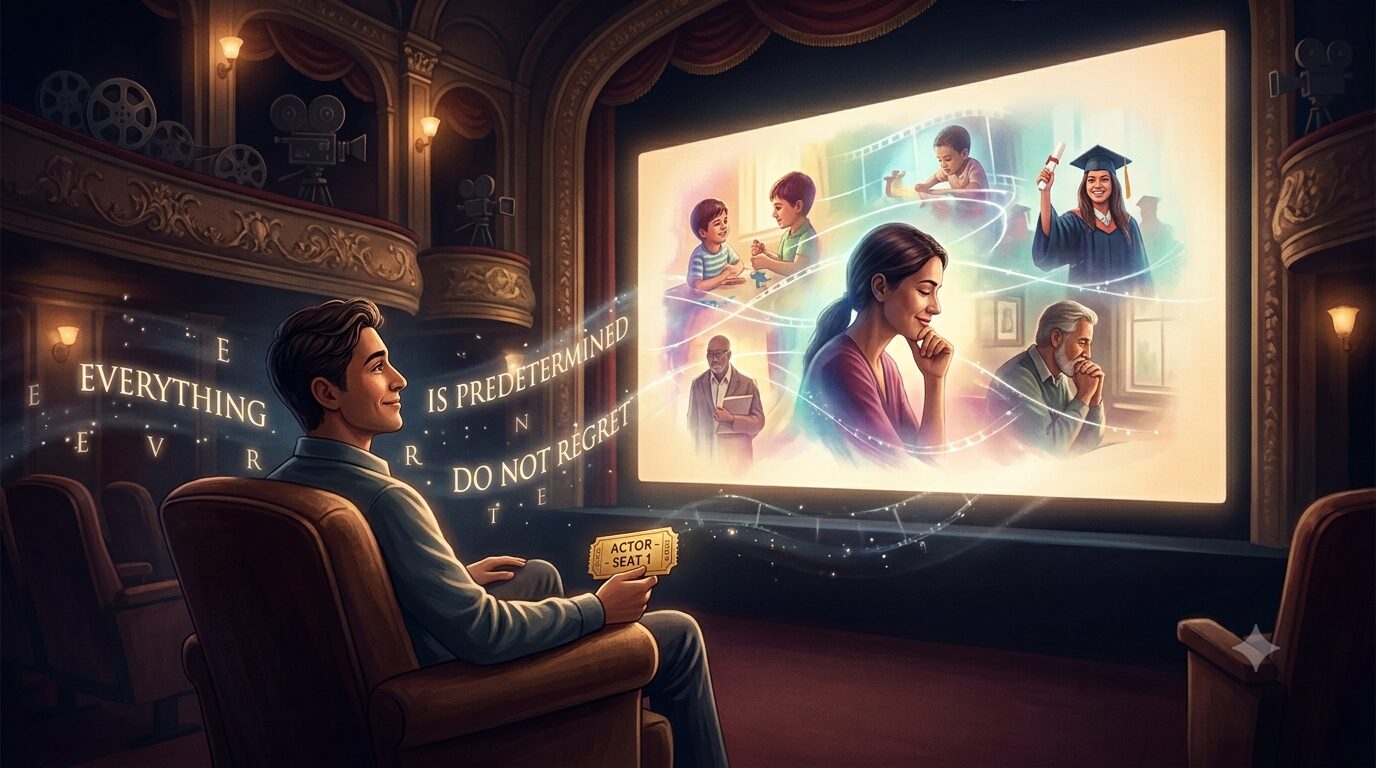
The Scripted Universe
Why every choice was inevitable, regret is an illusion, and peace comes from realizing you are the actor, not the writer.
Have you ever looked back at a moment in your life and thought, “If only I had done things differently”? What if science, philosophy, and basic logic prove that you literally could not have made a different choice? Once you grasp this truth, a profound weight lifts off your shoulders.
1. The Core Philosophy: Determinism & Causal Necessity
In philosophy, the principle of Determinism dictates that every event, including human action, is entirely governed by preceding events and natural laws. When you made a decision five years ago—or five minutes ago—your choice was the inevitable outcome of your genetic wiring, brain chemistry, upbringing, environment, memories, stress levels, and exact external circumstance at that precise millisecond.
To have made a different decision, you would have needed a different brain, a different history, or a different setting. Since you had none of those, your decision was the only possible outcome. You didn’t write the movie; you are simply acting out the scene already written by causality itself.
2. 20 Layered Realizations That Prove You Couldn’t Have Acted Differently
As we move through these 20 examples, notice how each build builds upon the last—moving from basic physics to neuroscience, psychology, and personal experience—further sealing the truth that you are completely free from the burden of regret.
Every atom in your brain follows the laws of physics. Just like dominoes falling in a line, every chemical reaction that fired a neuron in your brain was triggered by a prior physical state.
Your baseline patience, risk tolerance, emotional reactivity, and intelligence are bound to your DNA. You never picked your genes, yet they set the boundaries for every choice you make.
Your early childhood experiences wired your subconscious mind long before you had critical thinking skills. You evaluate life through lenses ground by past influences you didn’t choose.
Modern brain imaging (fMRI) reveals that your brain prepares a decision up to several seconds before you become consciously aware of “choosing” it. The decision was already made before “you” knew it.
You can only make choices based on what you knew at that exact second. Judging a past decision using today’s knowledge is like blaming yourself for not knowing tomorrow’s lottery numbers.
Whether you were low on sleep, low on glucose, or experiencing a surge of cortisol or dopamine dictated your brain’s processing capacity at that moment. You cannot out-think your chemistry.
If you rewound the universe back to 2:00 PM yesterday—with every single atom, memory, emotion, and external sound identical—you would choose the exact same lunch, say the exact same words, and make the exact same choice every single time.
Pay attention right now: what will your next thought be? You don’t know until it appears. If you don’t control the thoughts that pop into your head, how can you control the decisions they produce?
In high-stress moments, the logical brain yields control to primal survival mechanisms. Expecting yourself to have acted with calm wisdom under panic ignores basic brain anatomy.
The language you speak, the norms of your culture, and the expectations of those around you subtly dictate what you perceive as “acceptable options.”
Your willpower shrinks throughout the day. A poor late-night decision was simply the mathematical outcome of a tired prefrontal cortex depleted by earlier choices.
A subtle smell, a tone of voice, or a room’s temperature triggers subconscious memories that tilt your preference toward one option without your conscious realization.
The brain naturally seeks maximum energy efficiency. Given your energy state at any moment, your brain automatically defaults to the most accessible neural pathway.
Your values—what you hold as good, bad, important, or foolish—were formed by factors outside your control. Since values dictate choices, your choices were already shaped.
Nothing in nature happens without a cause. To claim human choices stand outside cause and effect requires treating the human brain as a supernatural anomaly exempt from physics.
After an event occurs, your brain rewires its memory to make the outcome look obvious. You feel regret only because your post-event brain forgot the confusion and pressure of the pre-event state.
You do not control traffic, the weather, other people’s actions, or unexpected news. These external factors constantly force your internal system to react in predictable ways.
Psychology shows personality traits remain strikingly stable over time. You act consistently with your character traits at any given age because that character defines your decision matrix.
You are the conscious observer experiencing your life unfold, not the engine driving every cellular spark. Just as you don’t manually beat your heart, you don’t manually fire your decisions.
Recognizing this chain of causality yields instant peace. If every prior step in the universe forced this moment, then this moment—and every past decision—was perfect in its necessity.
3. The Ultimate Shift: From Stressed Director to Peaceful Actor
When you understand this, the fear of making a “wrong” decision vanishes. You can stop frantically trying to micromanage a future that is unfolding according to its natural trajectory.
You are an actor in a masterpiece. You don’t need to panic about what line comes next—the script is already written. Your only job is to be present, enjoy the role, watch the story play out, and live without the heavy baggage of self-blame or anxiety.



Leave a Reply